Sunday, 18 April 2010

The Fat Duck, Bray


What must it be like, I wonder, being told you’re the best in the world? Or rather, what must it be like to believe it? It has to be a somewhat surreal experience for the staff at the Fat Duck, as they polish the cutlery and vacuum the carpets and shake down the tablecloths, to be aware essentially that this is it. Nobody in the world does this, this restaurant thing, any better. Anywhere. The front of house may appear charming and down to earth, like serving eggs cooked in liquid nitrogen and edible playing cards is the most natural thing in the world, but do you think behind the easy manner and practised ease of service there’s a twinkle of pride, that they really know how good they are? Do they even care?

Of course, people will try and tell you that El Bulli, at least until later this year when it permanently closes its doors to the paying public and relaunches as Ferran Adria’s Convalescent Home for the Culinarily Insane, is better. This is absolute rubbish. Not one of the bizarre and often downright disgusting “dishes” I ate in Spain last September could match even the weakest of the fabulous plates of food we were served yesterday afternoon at the Fat Duck. El Bulli serves toy food, technically impressive but vacuous experiments in form and texture, with all the personality of an eight-year-old with ADHD. The Fat Duck is a proper restaurant, its inventions never ever coming at the expense of form or flavour, and the warmth and wit of every element of every course had us grinning and giggling and cooing. Let’s start at the beginning.


A “palate cleanser”, lime mousse poached in liquid nitrogen and sprinkled with green tea dust, was an extraordinary sensation. The intense cold was shocking, and if you ate it soon enough after it came out of the nitrogen bath you could blow great white clouds of lime-scented smoke out of your nostrils. Hilarious, and most importantly, delicious.


Red cabbage gazpacho with mustard ice cream was a balancing act of vinegar and salt, and one which worked magnificently. First to register was the mustard ice cream, giving way to the strongly pickled cabbage as the flavours warmed up and mingled in the mouth. Simple – and very recognisable – ingredients, yet combined in such a way as to produce something memorable and unique.


And then, a life-changing course. “Jelly of quail, crayfish cream” sat in a cute tilted bowl next to a wooden block supporting a delicate black truffle toast. Both of these elements, it almost goes without saying, were divine, the crayfish and quail mixture simultaneously having the rich musk of deep woodland and the evocative tang of a rocky sea shore. It brought to mind childhood holidays in Spain, and of late afternoons in the countryside after a rain shower. We ate this dish, though, as the entire table disappeared under a soft blanket of bright white nitrogen, frothing and bouncing in between glassware and cutlery and spilling onto our laps. It was cleverly scented with a kind of soily, oaky, woody extract and for a few magical seconds it was like eating off the surface of a cloud. It was, quite literally, heavenly.


Next up, the famous “snail porridge”. Nowhere near as weird or challenging as its rather provocative name suggests, it was a wholesome, delicious bowl of deeply flavoured pea risotto topped with a couple of moist, perfectly seasoned snails and an aromatic topping of shaved fennel and Spanish ham. Gorgeous.


Roast foie gras with rhubarb had excellent, perfectly cooked foie and for want of a better word the most “rhubarby” rhubarb sauce I’ve ever tried. This is the kind of rather understated (albeit delicious) dish that tends to get forgotten about amidst the theatrics elsewhere but was nevertheless satisfying and impressive in its use of texture and technique.


The Mad Hatter Tea Party, of the Feasts television programme fame, was utterly magical. First of all we were presented with a bowl of intricately arranged delicacies, including a strongly-scented cauliflower and mushroom mousse and a kind of pressed ham terrine. Then a waiter arrived with a glass-topped box containing what looked like gold wristwatches, but were in fact highly concentrated beef stock covered in gold leaf. The “watches”, once dunked in hot water, dissolved into a hot beef “tea”, which you then poured into the bowl. This wasn’t just a gimmick – the concentrated stock had an amazing flavour (sweetened with Madeira too I think) and the rehydration from the concentrate enlivened the flavours and lifted the whole dish to something bordering on genius. I couldn’t stop giggling it tasted so astonishing.


“Sounds of the Sea” is a Fat Duck classic, and it’s very easy to see why. A slice of raw tuna, halibut and mackerel (each stunningly fresh, the finest sashimi I’ve ever had the pleasure to eat in their own right) were served on top of ‘sand’ made out of spiced tapioca and a shellfish foam. You eat this dish listening to a soundtrack of seagulls and crashing waves on a provided iPod. Sounds silly? Well yes, it was a bit, but I was having so much fun by this point I just kind of rolled with it. Yes, I’m eating fake sand from a glass plate whilst listening to seagulls on an iPod hidden inside a large conch shell. So?


I can see why salmon poached inside liquorice wouldn’t be everyone’s cup of tea. Of all the dishes yesterday, this was the most bizarre in terms of flavour combinations, and ironically this was the one most reminiscent of something that may have come from the kitchens at El Bulli. The salmon was, as you’d expect, perfectly cooked to just pink, and the liquorice was actually a very subtle note that was really more of a lingering aftertaste than a strong primary flavour. The artichokes cut through the fatty salmon very well, and more texture was provided in the form of tiny crunchy coriander (I think) seeds. It was very good where everything else had been mind-blowing. Hardly a criticism really.


The next two courses were actually served simultaneously (3 of us got one, 3 the other) and necessitated a spot of communal swapsies, which was a nice homely touch. Anjou pigeon was a superb bit of bird and came with a stunning black pudding and chocolate sauce. And a lovely pink lamb chop was served on a bed of some sort of clever cucumber remoulade thing – you don’t often see lamb and cucumber together outside of a middle-eastern wrap, but it made perfect sense here.


The lamb was served with what they bashfully described as “mash”. But this was no ordinary mash. This wasn’t even merely an excellent mash. This was mash of the gods, king of mash, the mash to end all mash. Light, frothy, cheesy and studded with tiny cubes of sweetbreads, it was hard to see how this could be improved upon at all, and certainly beats anything so-called mash expert Joel Robuchon ever did into a cocked hat.


The final proper main course was some godly pork belly on spelt, garnished with a couple of slices of earthily fresh black truffle. I can’t go on and on about every dish because I’m running out of superlatives, but yes it was the best pork belly I’ve ever had. What did you expect?


“Hot & Iced Tea” was a bit of clever technical wizardry matched with some rather nice tea. It looked like a normal glass of liquid, and certainly smelled like tea, but one half of it was cold and one half was hot. And I don’t mean hot below or above the cold in layers, I mean vertically down through the drink, the left hand side was cold and the right hand side was hot. Don’t ask me.


We had another mix and match dessert selection for the next round, with three of us receiving “Taffety Tart” and three a kind of rhubarb tart thing. The rhubarb was my favourite of the two, with more of that astonishing concentrated rhubarb flavour and a deliriously pretty presentation.


And after that, three of us had a “BFG” (Black Forest Gateau), as first seen in a slightly modified form on Heston’s In Search Of Perfection TV series, and three of us nitro-scrambled eggs with bacon and pain perdue. And yeah, it was all brilliant. Oh – just in case you were wondering, that cherry stalk on the BFG is edible. It’s made from dried vanilla pod. The attention to detail in this place is unbelievable.


The last course I personally ate in the restaurant was this clever whisky map, with little wine gums made from various different varieties which you peeled off in a designated order. It’s interesting just how much of the flavours of the original product survived the ‘wine gumification’ and made an extremely enjoyable end to the meal.


Or at least, nearly the end. I opted to take my final course home with me, as it came in a handy little bag marked “Sweet Shop” and contained various chocolate and confectionary items (all made in the restaurant) which I thought would be an idea to share with my flatmate. So later that evening we tried a toffee in an edible plastic wrapper which tasted of apple, a bag of coconut flavoured ‘tobacco’ infused with a real tobacco flavour, and most amazing of all what looked like a thick playing card (complete with very realistic design) but was actually a slice of white chocolate with an impossibly thin layer of raspberry jam inside. It brought giggles and gasps as I’m sure was intended.

So, the Fat Duck, the Best Restaurant In The World. Why not. Yesterday afternoon I spent four deliriously happy hours eating course after course of some of the greatest food I’ve ever tasted in my life, and almost as soon as it was over I wanted to do it all again. You can’t avoid the comparisons with the other pretender to the crown, so I won’t – El Bulli is pretentious and awkward where the Fat Duck is bold and refined; jarring and unpleasant instead of accessible and rewarding; infantile and daft rather than whimsical and playful. The £291 I spent here (£150 for the food, the £90 wine flight, a whisky and service) was worth every penny, of course, but it’s painful to recall that the last time I spent this much on a meal I left unsatisfied, unsettled and slightly queasy. I learned my lesson, and so should you – if you want to eat the food of the gods, dishes of warmth and clarity and singing of sheer (often literally) gold-plated excellence, there really is nowhere else. That twinkle in the eye of the staff I mentioned earlier, it is pride. It must be. You can hardly blame them.

10/10

Many thanks to Ben Bush for his pictures

The Fat Duck on Urbanspoon

Wednesday, 14 April 2010

Terroirs, Covent Garden


When you book a table at Terroirs, they ask you if you want to sit upstairs or downstairs. Having never been, it seemed sensible to reply "whichever is nicer", although it seems this question flummoxed whoever was manning the phones somewhat.

"Well, downstairs is bigger...?"

"Downstairs, then."

"We'll need the table back by 9pm. Will that be OK?"

I suppose it would have to be. After descending an impossible amount of stairs to a basement room so subterranean it had the atmosphere of a reclaimed mineshaft, I can confirm that downstairs at Terroirs is indeed bigger, and yet due to the remarkable popularity of this restaurant & 'natural' wine bar almost every seat was already taken. I was led up yet more stairs to a mezzanine level towards the back, and to a table that appeared to have been designed specifically for André the Giant. After a few moments gazing across a surface that only just cleared my chin from a sitting position, I called my waiter back and asked to be moved. Later in the evening, a second couple would be seated at the same table, make similar observations on the relative height of the chairs and dining surface, and also ask to be moved. Maybe Terroirs is abnormally popular with acromegalics, or perhaps it's just an elaborate practical joke. Who knows.


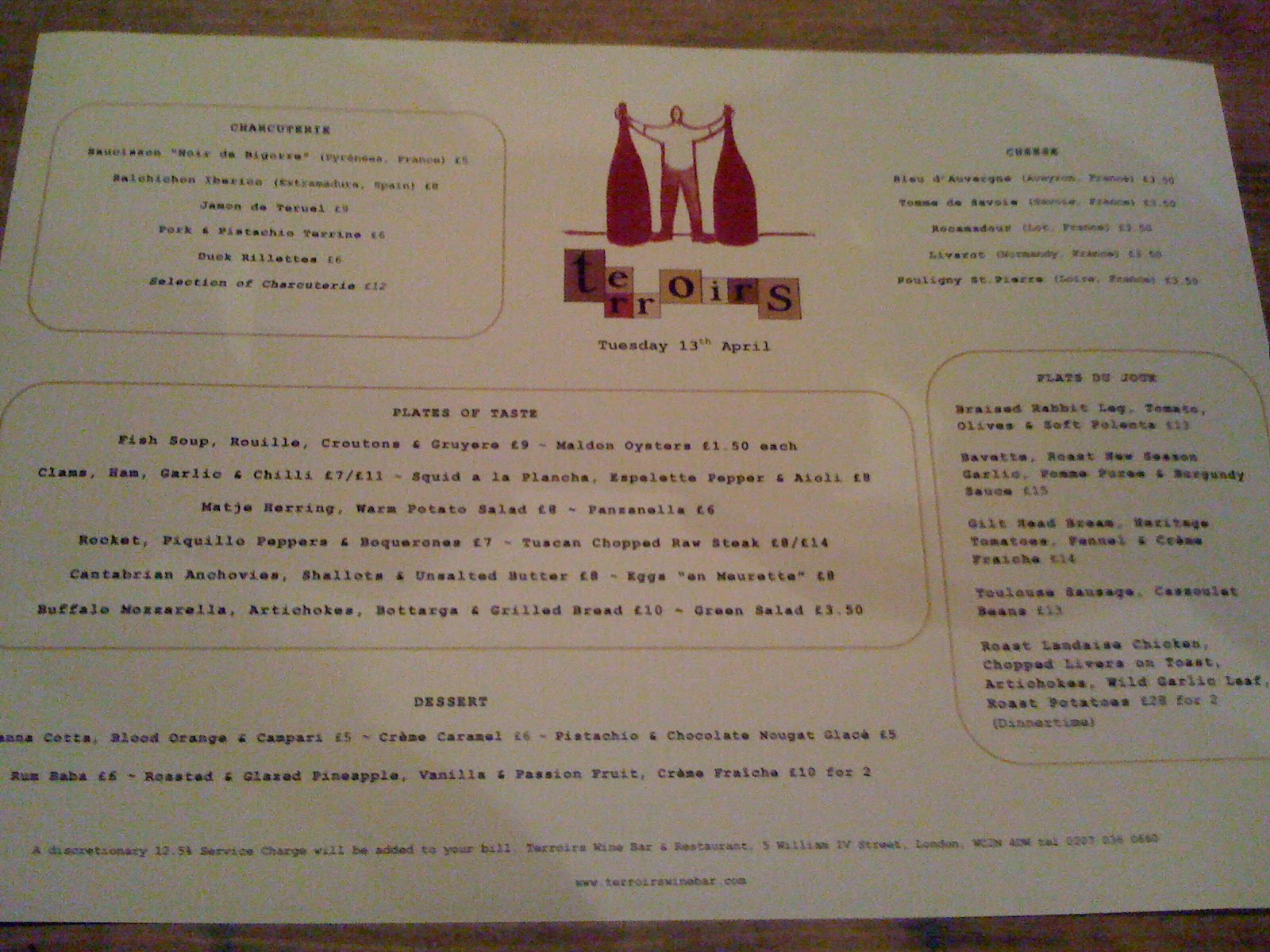
Sadly that table wasn't the only disproportioned or baffling thing about my meal that evening. First of all, I found the menu quite difficult to decipher. It was split into 'Charcuterie', which had five different cold options ranging from £5-9 each and a selection of three (you couldn't choose which) for £12; an area which looked like main courses labelled "Plats du jour" containing things like steak and potatoes and their famous cassoulet; and "Plates of taste" which as far as I could make out were just slightly smaller main courses, salads and soups.


The charcuterie selection was perfectly good - a very nice saucisson from the Pyrenees, a decent duck rillette and a generous block of pork & pistachio terrine with pickles. The terrine in fact was particularly good, with lovely moist pork and big chunks of crunchy nuts for texture. But just take a look at what arrived next:


What we have here is a huge mound of preserved anchovies (very nice they were too, to be fair), a few slices of shallots, half a pound (or so it seemed) of unsalted butter and just two half-slices of bread to spread it on. If I had divided equally all the provided ingredients onto those tiny bits of bread I would have ended up with a towering mass of traumatic salty, buttery mixture, both impractical to eat and probably fairly disgusting too. I don't know if I could have asked for more house bread without being charged another £1.50, but I wasn't going to risk it, and so we just shovelled in as much butter and anchovy as we could without gagging and left it at that. I estimate we left about half the anchovies and 3/4 of the butter.

Clams, ham, garlic and chilli were interesting enough and had nice fresh clams, but there was probably about a tablespoon of edible ingredient here for your £7. I realise that most, if not all, of my issues so far can be explained away by bad ordering, but we were not offered any suggestions from the staff and I do think that the menu was confusing. Well, that's my excuse.


Given that after the "mains" we were desperate for something to wash away the salt and butter, and to fill up our stomachs (respectively), we ordered desserts. Panacotta was pretty good, with a nice bitter Campari and orange accompaniment which did its job well.


Rum Baba, sliced in half and doused with rum at the table, was a bit more of a chore. The first couple of mouthfuls were delicious, moist and sweet and with a pleasant burn of alcohol. But after a while the dense cake became hard-going, and the pot of cream wasn't light or sharp enough to cut through the stodge and make things any easier. I left about half of it.


The bill came to about £60, which is a fair price I suppose but the whole experience had left me extremely uncomfortable, and I'm not just talking about that table. The dishes, though well-cooked and using good ingredients, were clumsily constructed and often unforgivably imbalanced, making the eating of them more of a challenge than a pleasure. I really wanted to like Terroirs, and clearly plenty of people do, but perhaps in the future I'll pay more attention to their excellent wine list (Terroirs at least have the distinction of selling me the first and only glass of "natural" wine I've ever enjoyed - a Vouvray - and their rosĂ© was equally impressive) than the food menu. In fact, if you approach Terroirs as a wine bar that can serve you the odd bit of food to stop you falling asleep on the train home, then perhaps you'll enjoy it more than I did. Order carefully and make sure you're clear on the portion sizes, and you'll probably get along fine. Oh, and watch out for that table.

6/10

Terroirs on Urbanspoon

Tuesday, 6 April 2010

Viet Grill, Kingsland Road


Mien Tay Battersea is a wonderful restaurant, serving spectacular food at miniscule prices, with staff so smiley and warm you want to take them home with you. It would be a wonderful restaurant anywhere in London, of course, but as I've mentioned before, its location on Lavender Hill is nothing short of a miracle, and has probably single-handedly raised the nearby house prices to a statistically significant degree. But it's too easy to forget that back where it all began for Vietnamese food in London, on the Kingsland Road in the East End, there are a selection of restaurants who regularly give Mien Tay a run for its money, and fuel the virtuous circle of competition and higher standards that we've come to expect from this most exciting and satisfying of cuisines. One of these restaurants is the Viet Grill.


Unusually for reviews on this blog, this isn't my first visit to the Viet Grill. I usually try and write up places after a first visit, which is perhaps not a completely fair method (to say the least) but is at least consistent, and I estimate I've eaten here well over twenty times since I discovered it a couple of years ago. Other than a lick of paint and the occasional change of staff, though, not a great deal has changed, so I hope this is as reliable a review as any other I've posted. Not very, in other words. But here we go anyway.


If there's one thing that the Vietnamese can do better than anyone else, it's a salad. It's mainly a texture thing - the combination a multitude of ingredients that go pop, crunch, squish and splosh, all on one plate, is addictive and unique, as far as I can tell, to these kinds of restaurants. This mango salad contained fragrant Thai basil, tasty shoots of (I think) lotus stem, a couple of hits of bright red chilli and - best of all - crunchy tubes of salty dried squid tentacles, and it all worked together perfectly. All the fresh, fragrant ingredients not only made an incredibly tasty dish but even made you feel like you were doing yourself good when eating it. And you can't often say that.


Crispy spring rolls were perhaps quite a tame choice (we had eaten the delicious summer rolls on many previous visits and fancied a change) but were deftly fried and had a greaseless crunch. They came with a thin, vinegary chilli dip which was a cut above your average gloopy sweet sauce, as you'd expect.


This beautiful, tender, charcoal-seared 'Feudal roasted beef' was at £9 one of the more expensive starters, but boy do you get your money's worth. First of all, the sheer quantity of it, which would by most restaurants standards be a good main course portion, and also, the beef itself was superb, powerfully marinated and served with an umami-rich soy dressing.


I didn't know what to make of the Saigon pork belly dish when it first arrived - it looked challenging to say the least, the huge cubes of fat wobbling provocatively in the caramelised coconut sauce. But on tasting, all was forgiven. I admit to separating the majority of the fat from the meat and leaving it uneaten - there was too much of it even for me - but the coconut sauce was rich and moreish and the stewed pork pieces had fantastic strong flavour.


Along with a couple of bowls of steamed rice (which I used to soak up the rest of the pork coconut sauce) and a couple of glasses of wine, the final bill came to £20 each, perhaps slightly more than the same meal might have been at Mien Tay but in nicer surroundings and with certainly a comparable level of cooking. Kingsland Road is a fine example of what can happen when restaurants all compete on the same style of cuisine, and instead of trying to survive by slashing ingredient costs and employing pushier fronts of house (a la Brick Lane) instead try to outdo each other by serving better food. It's the way it should work and yet so rarely does. And the results speak for themselves.

9/10

Viet Grill The Vietnamese Kitchen on Urbanspoon

Friday, 2 April 2010

The Cadogan Arms, Chelsea


There I was on the bus, reading Marina O'Loughlin's enormously satisfying evisceration of Zilli Green last Wednesday morning, and something struck me as strangely familiar. Not the writing, which was unique and as vivid as ever (on a tofu dish - "this is a ceiling tile in clumsy drag"), and not even the fact that yet another Aldo Zilli restaurant is revealed to be a cack-handed, cynical vanity project - that too is par for the course. What I recognised was the photo, the very same as that which had graced the top of the Harden's review from a few weeks before. Now I'm guessing that neither O'Loughlin or the Hardens boys had anything to do with the photo that was used to illustrate their pieces - presumably it came from the restaurant PR people and was supplied long after the review - but it did get me thinking. Call me an old-fashioned, self-serving food blogger cheerleader (and many more besides), but I like to see pictures of the food, a room full of happy diners and busy waiting staff, even action shots of the chefs. What I can't see any value in is a perfectly made up, beautifully-lit still-life of a deserted restaurant. Which is ironic, because this was the first picture I took as I entered the Cadogan Arms:


Beautifully lit and professionally shot it may not be (you must know how this blog works by now), but even so, this is no staged PR clipart - this is how the place looked at 1:15pm on Easter Friday afternoon. And, by God, we were about to find out why.


First of all, an £8.50 Bloody Mary, watery and unsatisfying, and shot through with unpleasant chewy bits of horseradish. It was garnished with a stick of celery dipped (pointlessly) in pre-ground course black pepper which throughout the course of the afternoon shed tiny dark lumps onto the tabletop, managing to find their way into clothing, under fingernails, and into the desserts. I'm not going to go into a great deal of detail about the dishes that followed, because everything that is wrong about the Cadogan can be summed up in this drink - badly conceived, badly constructed, overpriced, pretentious, and irritating.


Briefly, then, the food. A starter of steak tartare may have used pretty good fillet steak, only thanks to the sheer amount of mustard they'd put in you couldn't tell. It was a bit like eating lumpy mustard, with a raw egg on top.


My main course was a whole baked mackerel. The best thing you could say about this dish was the flesh wasn't overcooked. The worst thing you could say was that it was a leather-bound, underseasoned chore, surrounded by three weird stone-cold barrels of aubergine-wrapped tomato thing, and some cold slimy mushrooms. A companions 'bubble and squeak' was also stone cold, with a shockingly bitter hollandaise and accompanied by an overwhelming reek of cheap truffle oil.


I don't know why we ordered desserts. Perhaps it was the fact we were both still hungry after barely picking at our mains, or perhaps we were just morbidly fascinated to see what else they could cock up. My deep-fried jam sandwich, a la 60 Hope Street Liverpool, was flabby and unattractive, and tasted like eggy bread covered in jam. It's not supposed to, in case you were wondering - 60 Hope Street is my favourite Liverpool restaurant and the original, though actually not the best dessert they do these days, is far better. Worse, though, was my companion's three pathetic cubes of marshmallow, accompanied by a tiny lump of peanut crackling and a small jug of cold (yes, cold) chocolate sauce. Badly conceived, badly constructed, overpriced, pretentious, and irritating. Are we getting the picture yet?


I don't know why the Cadogan Arms has been getting such good reviews recently - I'd be tempted to write it off as a bad night, or perhaps as it's Easter the head chef wasn't there, but I honestly can't see how some of these dishes - particularly my leather-baked mackerel with aubergine cylinders, or that weird marshmallow thing, would have worked even anyone in the kitchen HAD given a shit.


In case anyone is still on the fence, and is in any tiny way inclined to give the Cadogan Arms another shot - consider this. Although my Bloody Mary cost £8.50, which I take full responsibility for, my companion's lime and soda cost £3. I'll say that again - a lime and soda at the Cadogan will cost you £3. One more time, with feeling - badly conceived, badly constructed, overpriced, pretentious, and irritating.

2/10

Thanks to Andrew Webb of eyedropper for inspiration on the blogger vs. professional photographer bit

EDIT 8/4/10: A very contrite Cadogan Arms have emailed to point out that my Bloody Mary was £6.50, not £8.50, so I'm happy to correct that point. It was still crap though.

The Cadogan Arms on Urbanspoon

Tuesday, 30 March 2010

Cheese of the Month - Charolais


Having snapped up this pretty little barrel-shaped Charolais in Hamish Johnston last weekend, in a bit of a rush to get back to the house and light up the barbeque before the heavens opened, I assumed that I could Google the important details at a later date, tack on a tasting note or two, and call it a review. After all, that's how this process normally works. I don't, believe it or not, have an encyclopaedic knowledge of cheese - in fact I'd be lost without sites such as Fromages or http://www.slashfood.com, where the intimate particulars of almost every cheese you can think of is listed in extraordinary detail. Very handy they are indeed, to a chancer like me.

But while pulling together a set of notes for Charolais, I came across a number of annoying inconsistencies. Charolais is "traditionally" made, according to Fromages, from a mixture of one part cow's to two parts goat's milk, and although production varies from farm to farm - this is after all an artisan product, not a Kraft cheese slice - from the handful of sites I've browsed it seems this element of mixing and tweaking the mix of cow's to goat's milk is an important part of the character of the cheese. And yet what's this - on 23rd January 2010, according to Slashfood, Charolais became a AOC label cheese, and as part of the strict criteria that comes with this poisoned chalice, using cow's milk in any stage of the process is now strictly forbidden.

I'm a bit grey on these AOC and DOP badges. Protecting culinary heritage and artisan producers is all very well, but it seems odd that a group of bureaucrats can in the year 2010 suddenly put a stop to a perfectly valid method of producing perfectly good cheese that's been going on since God knows when. Or if not put a stop to it then prevent people calling it Charolais. I'm sure they think they're preserving authenticity but in the end it's them that's decided what's authentic in the first place.


The reason I mention all this is because this authentic, authenticated and genuine Charolais, presumably made from 100% goat's milk because them's the laws nowadays, didn't really excite me very much. The texture, first of all, was very uniform and cloying - moisture is usually a good thing but this was rather unpleasant; it coated your mouth like putty. And there wasn't much going on in the flavour department either. At first there was almost literally no flavour at all, but then a hint of a grassy aftertaste prevented the whole thing from being a complete waste of time. Still, it's hardly a ringing endorsement of the strict new designation - if is an example of an AOC Charolais then I can't really see why it was worth protecting in the first place.

So the question is, would this cheese have been any better if the producers had been allowed to use a mix of cow's and goat's milk to their liking, or tweaked various other elements, even if they wouldn't have in the end been able to call it Charolais? My instinct says yes. The habit - and I'm mainly talking about France and Italy here, though there are other examples - of obsessing over and dictating the ingredients, process and geographic location of a cheese at the expense of ending up with a product that is actually any good to eat, seems incredibly counter-productive. If someone started making an Epoisses-style cheese in Canada (don't laugh) and it tasted just as good, I'm sure there would be very few people who would care that it wasn't "authentic". Then again, the Canadians wouldn't know what to do with a cheese that you couldn't melt onto chips, so it's probably nothing we'll ever have to worry about.

3/10

Tuesday, 23 March 2010

Bob Bob Ricard, Soho


Bob Bob Ricard is a strange, glittering fantasy world at the best of times, as opulent as Versaille and as superficial as Oz, its chandeliers and emerald green lamps leaving just enough in the light to be beautiful, and just enough in the dark to be inscrutable. It's not so much like stepping back in time as stepping into another universe, or taking a trip on the Hogwarts Express to Wonderland, where bizarre details ("Press for Champagne") lurk at every turn, and charming staff in powder pink uniforms prepare psychedelic cocktails and serve beef soup from a teapot. Returning for the first time after the infamous Vintage Vodka Tasting evening, however, was an even more peculiar experience than normal. Occasional details and tastes would trigger a memory of groggy vodka-laced incident from last month, provoking a hot flush of shame or a sharp uncontrollable guffaw, or very often both at the same time. I'm sure my dining companion thought I was going mad. Perhaps I was.


But I said I'd be back, and here I was, settled into a cosy green booth and sipping on an extraordinarily good rhubarb gin and tonic, sweet and frothed with egg white. A vodka Appletini was equally good, served ice cold and in lovely glassware. Based on this evidence it would be well worth just popping into Bob Bob Ricard's downstairs bar for a cocktail, but then I'm not entirely sure it's possible to just "pop in" to Bob Bob Ricard at all. You never really feel in control of your own actions in this place - you're stealthily manipulated into having a good time, whether you like it or not.


I had specifically returned for the Zakuski - bite size Russian dishes served with ice-cold premium vodka. The pickled herring and boiled potato was as good as I barely remember, and salmon roe on quails egg was a delicious combination of soft egg and salty, bursty roe. Kauffman vintage vodka washed them down far, far too easily, and was again served in very attractive glassware, the immediate sight of which whisked me back a month and to a vision of me trying to decide which of two forkfuls of ox tongue in aspic I was holding up was real and which wasn't. I hope I guessed correctly.


The Bob Bob Ricard burger turned out to be one of the best I've tried in London. I won't go so far as to say this was a surprise - nothing in BBR is a surprise, your expectations are assaulted and confounded so frequently the abnormal becomes normal - but it was certainly welcome. Good quality beef, cooked perfectly medium, and a good strong sesame bun. Word has it that BBR are soon to launch an authentic American burger, using Kraft cheese. Another reason to go back, damn them.


A second main course - a special - of roast veal, foie gras and black truffle jus was simply wonderful. Light, pink veal, sliced into delicate pieces, sat on top of a bed of juicy spinach and beside a generous slab of wobbly, buttery foie. And the black truffle jus was so good (and came in such quantity) I ordered extra bread to soak it all up, only just resisting the temptation to drink it straight out of its silver serving jug. One of the best dishes I've eaten all year, and proof that Bob Bob Ricard seem to be able to master French cuisine as well as they do everything else.


I hardly ever order desserts, but I couldn't leave without trying some of their homemade ice creams, including a delicious salty caramel. I was probably too full to make the most of them, but sadly I didn't have a choice in the matter. The restaurant chose for me.


At the end of the evening, I'd spent too much, drunk too much and eaten far too much, but I can't say I feel too guilty - it was all essentially out of my hands. Bob Bob Ricard is a huge, manipulative, mind-altering experiment in decadence, and if you can relax and surrender yourself to their whims and fancies you are guaranteed a good time. Far too much of a good time, in fact - far too much than is good for you. You may think I'm exaggerating, that I'm a glutton and a hedonist and weak-willed. Perhaps you're right. But if you sat down at a table, plush and inviting and romantically lit, and saw a button shining beside you marked "Press for champagne", can you put your hand on your heart and tell me you wouldn't press it? Honestly?

Didn't think so.

10/10

Bob Bob Ricard on Urbanspoon

Friday, 19 March 2010

Bar Pepito, Kings Cross


Spanish cuisine is one of the things that London seems to have been doing very well of late; I've never had anything less than a great meal in all of the Brindisa outposts, and places like Dehesa and Salt Yard are consistently excellent, so I was understandably frothing with anticipation at the prospect of visiting London's first, dedicated sherry bar. The idea appealed hugely, and seemed eminently sensible. Think of how many "fusion" restaurants are actually any good - when was the last time you went anywhere that did an excellent fish and chips AND an excellent Thai green curry? It just doesn't happen. The key to a good restaurant or bar is not to try and be all things to all people, but to focus on what you're good at, and do just that one thing VERY well. You won't find Tayyabs putting chicken korma on the menu because some people don't like spicy food - those people just won't go to Tayyabs. And quite right too.


I would have happily blown my own hard-earned cash on an evening supping chilled Tio Pepe and folding in slivers of freshly-carved JamĂ³n ibĂ©rico, and in fact very often have, but I was lucky enough to be invited to Bar Pepito on the press night, and didn't pay for any of it. This report, then, comes with the usual caveats that apply to many of these press launches - they give you far more free booze than is good for you, the service is eager to impress, and the PR people are charming and informative. But I have a very strong suspicion that even without any of this, I still would have fallen in love with the place. First of all, it's a lovely little spot, tucked away in an old warehouse around the back of Kings Cross, with attractive bare brick walls and and a very authentic Iberian feel. Secondly, the quality of the tapas is absolutely top notch. Not only do they have a wonderful selection of Spanish cheeses (albeit sweating slightly in the heat of the room - an airconditioning unit will be required to get them through the summer months I think), but they also have a qualified "Master Carver", who last night was expertly carving a leg of genuine pata negra into a plateful of delicate wafer-thin morsels.


And last but not least, the sherries. Despite the owners being Gonzalez Byass they have a commendably liberal selection from other producers, neatly categorized into 'Manzanilla', 'Amontillado', 'Fino' and so on. The Tio Pepe Fino (£3.50 a glass) was as good as ever, but I also managed to try a glass of a sweeter 'Matusalem' (£5.50) which went very well with the cheeses. I'm a complete sherry novice, and I'll leave it to others far more knowledgeable and qualified than me to go into more detail on the drinks, but I thought they were both superb.


Sounds like the perfect bar, so far, doesn't it? And that's kind of the problem. It is. And in a part of town crying out for just this kind of post-work casual-but-different drop-in spot. And it's attractive, and reasonably priced (a plate of that lovingly-carved, top-quality Iberico is £15, a steal compared to some places), and friendly. But it's absolutely tiny. With barely a half dozen customers Bar Pepito would feel buzzy - in full flow on a Friday night I'd be very worried you wouldn't fit inside at all. But then again, the courtyard outside has tables and chairs, and soon summer will be here and happy customers will spill outside with chilled Fino and plates of ham and all will be well with the world. Until then, I strongly urge you to visit Bar Pepito before the secret's out and it's packed to the rafters every night. Because it will be. You mark my words.


I was invited to review Bar Pepito. Initially they will open Wednesday to Saturday from 5pm until midnight.

Bar Pepito on Urbanspoon