Showing posts with label Lancashire. Show all posts
Thursday, 12 December 2019
The White Swan at Fence, Lancashire
It's hard to imagine now, but on the run-up to my latest trip to Manchester it was the Bull & Bear I was certain was going to be the weekend's rip-roaring success of a flagship meal, whereas the White Swan at Fence I was more uncertain about. Michelin stars tend to do strange things to rural gastropubs - prices creep up, service becomes more formal, menus more elaborate and fussy. I'd heard good things, of course - I'm not about to waste good money on a complete gamble - but I'd been trying to keep my expectations in check, and if nothing else the previous day's Sky-Sports-Sponsored weirdness certainly helped with that.
I needn't have worried. From the moment we stepped inside this handsome Victorian building, given the warmest of welcomes and shown to our cosy table next to the fireplace, it was clear everything was going to go very well indeed. It's often a tricky balance to get right, holding on to your soul as a community pub while acknowledging the kind of expectations (and prices) that the Michelin accolades bring, but the team at the Swan have created an atmosphere of easy grace and geniality that feels absolutely right for the occasion, and the kind of food they're serving.
Food, by the way, that's amongst the very best I've ever eaten in the country. The menu - at lunchtime anyway - is charmingly short, just two choices each for starter, main and dessert, plus the option of a tasting menu featuring presumably slightly smaller portions of all of the above. It's a mini work of art in itself, with suppliers namechecked, premium ingredients highlighted, and yet accessible - there's nothing too clever-clever or pretentious. The whole operation, in fact, from the décor to the menu to the Christmas decorations, speaks of a group of people with absolutely exquisite taste.
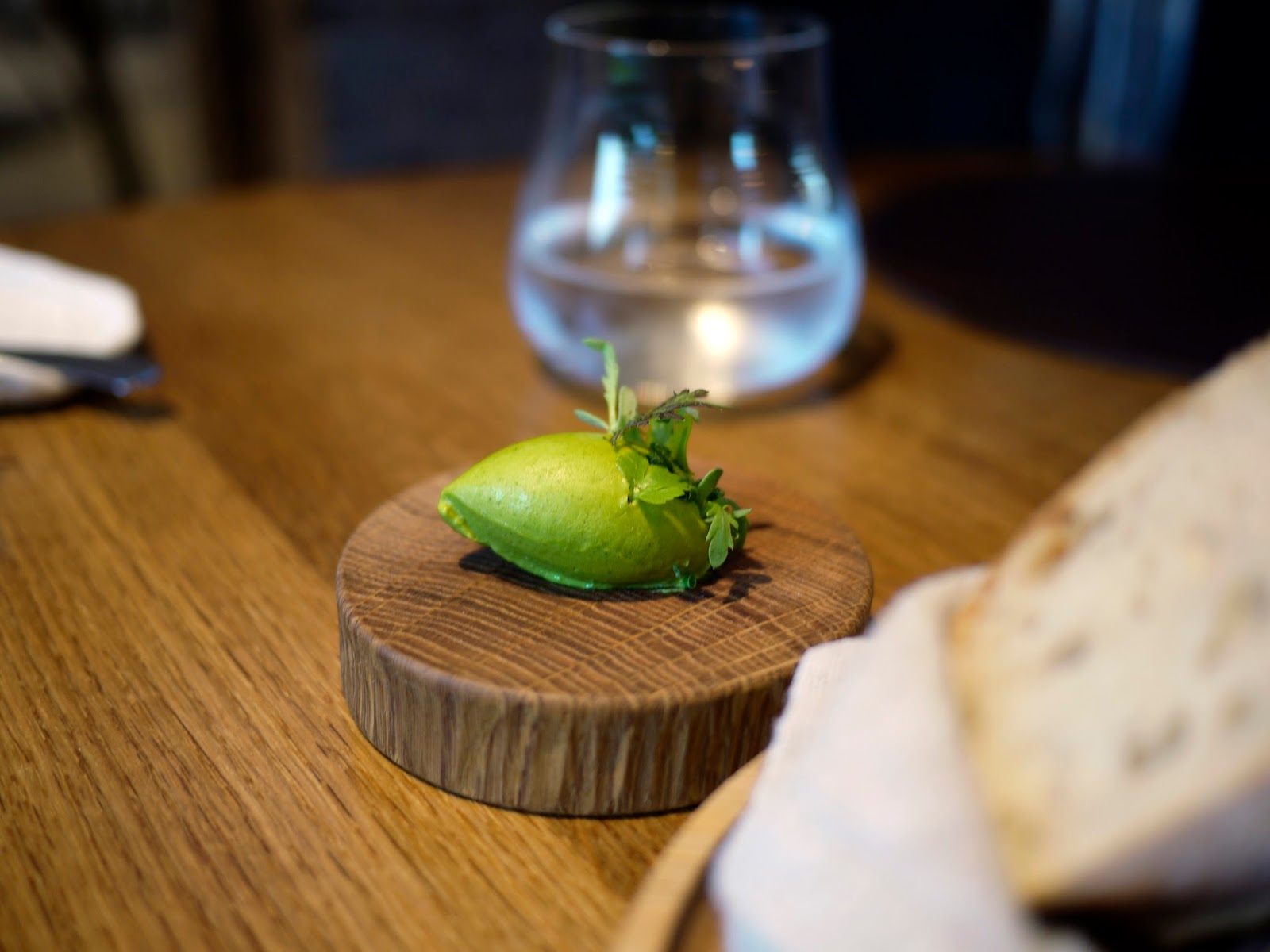
Bread came out first. Warm crusty buns, with an interesting scone-y texture, with a neat quenelle of room-temperature butter (good) and a portion of chicken liver parfait with shaved foie gras (so, so good). For a kitchen to come up with a parfait this notable and give it away as an unadvertised extra to every table shows both a generosity of spirit and a determination to impress in every given moment.
Then, a pretty stoneware beaker containing a tomato consommé covered with basil foam and topped with a few bits of crunchy pancetta. I had forgotten to advise that one of our party was pescatarian, but a replacement consommé was whipped up in less than a minute (the same, minus the pancetta presumably) which just show you how smooth the front of house are and how efficient the kitchen. It had a good deep tomato flavour, the basil as good a match for it as you would hope, and it all added up to a very pleasant, warming little introduction.
I'd like to tell you about the warm smoked salmon starter - with wasbi buttermilk, apple, yuzu and herring roe - and I'm sure it's lovely, but nobody on our table wanted to sacrifice their celeriac 'risotto' with Perigord truffles, so I'll have to tell you about that instead. Once it arrived, nobody regretted their decision. Tiny rice-grain sized chunks of celeriac actually make a better base for a risotto than most risotto rice I've tried, the parmesan came both as a kind of super-tasty hollandaise and shaved on top, and of course a few huge slices of winter truffle added extra seasonal cheer. Refined without being boring, attractive without being prissy, this was an absolutely great dish.
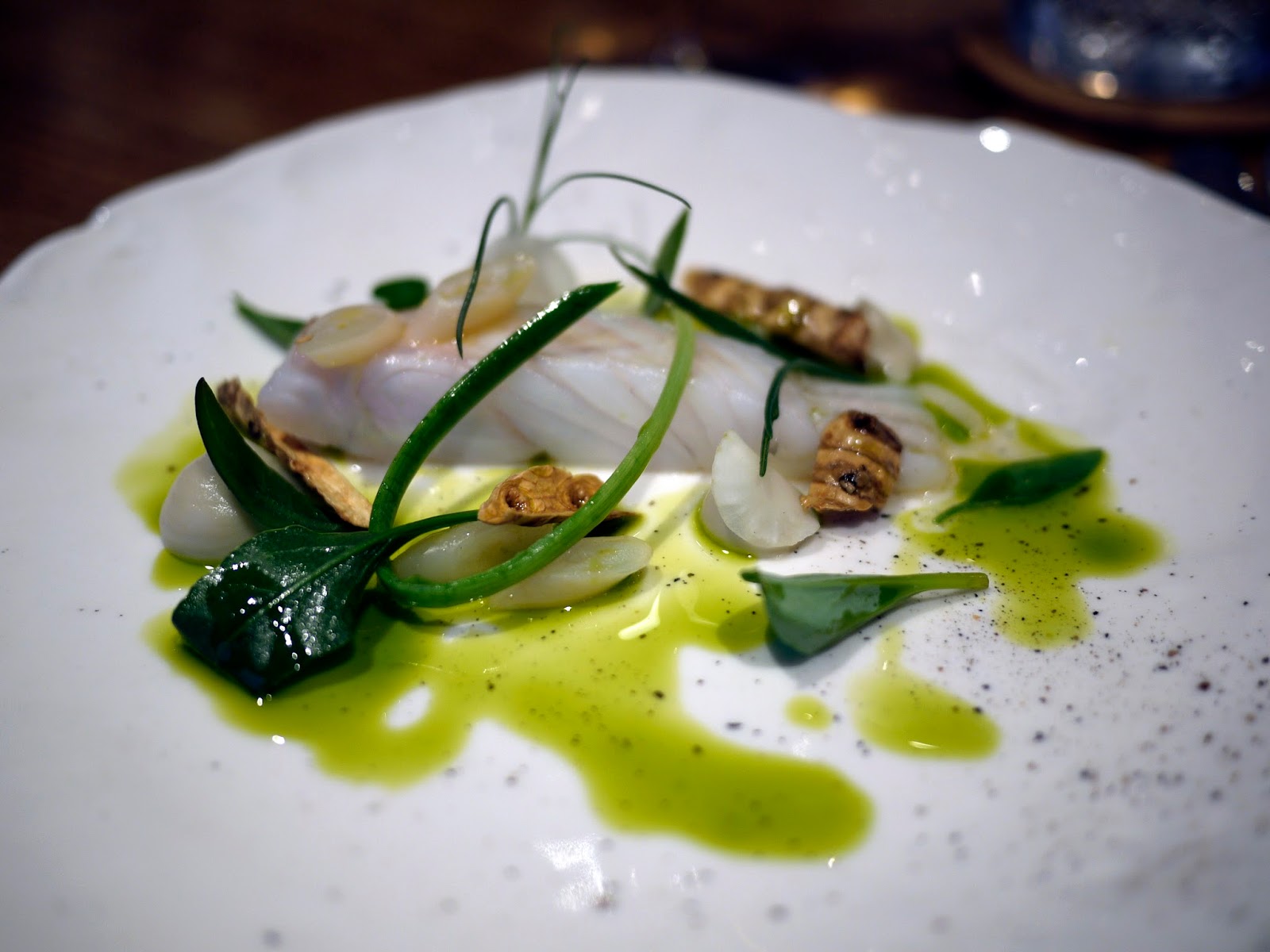
Fortunately, thanks to the pescatarian, I can tell you about both mains, although having tried the Isle of Gigha halibut with spiced onion fondue, saffron, red prawn and tarragon, I can assure you the fish option was hardly a runner-up. Beautifully cooked, meaty halibut, skin gently bronzed, was topped with a single plump red prawn, sweet and satisfying, and all sat in a frothy sauce that was so superbly balanced between dairy and umami seafood that it drew gasps from all of us, one at a time, as we tried it.
Suckling pig came as a tender medallion of pink loin, and a neat section of belly, a delicate layer of skin crisped up like the finest pastry. With it, silky-smooth blobs of cauliflower purée, roast shallot (or pearl onion, not sure) filled with some kind of light mayonnaise, little sprigs of I think broccoli, look it doesn't matter, all you need to know is that it was elegantly presented, technically stunning, and tasted so good you never wanted it to end.
By this point, despite the fact our appetites were beginning to fail us (a portion of super-crunchy triple-cooked chips had plugged any gaps left by the starters and mains) we asked if we could cheekily share one cheese course between 3. They obliged, of course, and proceeded to wheel over what is surely the most impressive cheeseboard in the North West of England. All bases were covered, from washed-rind to blue, and though local makers were featured there were a couple from the continent too. In the end we settled on a Langres, a creamy English blue which I've forgotten the name of (sorry), and the best cheese in Britain bar none, Martin Gott's St James. They were, in case you even needed to ask, perfectly kept and the perfect temperature.
Desserts continued the theme of just being blindingly good in every way. A pre-dessert of caramel custard was like eating a melted Mars bar - this is of course a good thing - and Sticky Toffee Pudding came arranged as a kind of festive tart, topped with winter nuts and berries and a very nice ice cream.
Mango soufflé, an impressive enough bit of work by itself having risen beautifully, came with more top ice cream work, this time coconut flavoured, and a generous jug of heavenly white chocolate sauce. Like everything that had come before, it was sophisticated, elegant and a masterclass in technique but also, most importantly, a riot of flavour.
You'll have probably guessed where I'm going with all this. The White Swan at Fence has, in the dying days of 2019, leapt straight into my own personal top 10 restaurants and may even have nudged the top 5. Everything that's life-affirming and joyous about eating out has been studied, worked at and executed flawlessly, a perfect dance of harmony between a charming (there's that word again, but they really are) front of house and a world-class kitchen, everyone seemingly having the time of their lives. It's deeply infectious, and utterly wonderful.
And so for a restaurant that does everything right, and nothing wrong, it inevitably follows I have to give it my highest mark. For only the second time this year, I've been lucky enough to be served a flawless meal by a small, passionate team that love what they do and communicate that love in spades. You'd have to have a heart of stone to not utterly fall for everything about the place, and I just can't say enough good things about it. But maybe I'd better stop for now, and give you a second to get on the phone and book a table yourself. It'll be the best decision you'll ever make.
10/10
Thursday, 16 August 2018
The Freemasons at Wiswell, Bowland
I know I end up saying this whenever I write up anywhere in the countryside but good lord, Lancashire really is a beautiful part of the world. An hour's drive out of Manchester or Liverpool you are plunged into rolling hills, narrow lanes and picture-book stone-built villages like Whalley, Waddington and Ribchester, each boasting at least one gorgeous old pub with a verdant beer garden, and with miles of tranquil footpaths connecting them all. It would be easy to have a very pleasant time here even if all said pubs were serving was frozen scampi and Carling, and indeed many of them do. But on top of everything else, this neck of the woods is also home to places like the Inn at Whitewell, the White Swan at Fence, and the Parkers Arms, serving some of the very finest food in the entire country.
Another proud member of the Lancashire foodie elite is the Freemasons, tucked away up a narrow alley on the top of a hill in the achingly pretty village of Wiswell. It had been on my wishlist since it started appearing on the Morning Advertiser's Top 50 Gastropubs list, but when it broke the top 10 I decided it was finally time to go to Bowland for dinner and not go to the Parkers Arms again, a difficult decision made over many weeks that left me genuinely traumatised. Even as we headed towards Wiswell on that Saturday morning I was seeing if I could invent reasons to divert to Newton after for a summer berry pie or marmalade ice cream. Which I realise doesn't display much confidence in the Freemasons, I just really really like the Parkers.
Anyway, I needn't have worried. The Freemasons was well worth the trip on its own, and left us with a smile on our faces despite the efforts of a large, noisy group of bellowing imbeciles to derail it all. I should have said something when they pointed us towards what would otherwise have been a lovely window nook corner table, because even at that stage they were making enough noise to be heard from the street. But as the lunch wore on and the amount of beer consumed increased, we gave up attempting to hold a normal conversation and resorted to the occasional shriek of "this is nice" above the cacophony from next door. I've had more relaxing lunches.
Objectively, though, and ignoring the idiots for now, the food at the Freemasons is pretty impressive stuff. Pea soup, emerald green and combined with a rich cheddar fondue, was the perfect way to start a lunch, with texture provided by what I think were little bits of puffed wheat. I always think a soup is a good test of a kitchen's skills; technique, seasoning and stock work all need to be on-point and if you slip up on any of them you'll end up with a bit of a mess. This was great, though.
Flame-grilled mackerel had a fantastic dark crisp skin, smokey from the grill, with a colourful mint dressing and neat cubes of cucumber. The standout element of this dish however wasn't the fish itself, or the mint dressing, but a quenelle of horseradish ice cream, smooth and peppery and quite the most enjoyable thing involving horseradish I can remember eating in a long time.
Courgette flower filled with shellfish was another clever showcase of a range of tricky techniques, the flower encased in a transucently thin tempura batter, and the shellfish mixture fresh and full of flavour. I'm still not 100% convinced of the wisdom of adding strawberry to the sauce vierge, which seemed an experiment too far, but I'll forgive them that as everything else about it was so nice.
Duck leg and anchovy is a marriage that's always going to work, and piled up with summer herbs, pickled radishes, fresh peach and a lovely zingy plum sauce, this was about as good a way of eating roast duck and anchovy as you could imagine. Working within the confines of a gastropub style of presentation - ie. no cylinders, no tuilles, no foams or smears, just ingredients presented and dressed simply - the Freemasons makes everything look easy, though one taste of the plum sauce or that pea soup is enough to demonstrate that a huge amount of work and technical expertise goes into some elements of the dishes.
Haddock, the fillet coated in breadcrumbs as a large flat "fish finger", came with more colourful summer veg including an almost neon yellow lemon oil. Again, everything here was cleverly done and colourful, the fish flaky and fresh and the vegetable accompaniments chosen well.
On paper, "Suckling pig pie baked in brioche, XO sauce, buttered Jersey Royals" looks like the kind of dish that could change lives. And when it arrived, glossy and gleaming on the table and soaked in a dark, thick sauce, I was absolutely expecting it to be the highlight of the entire meal, if not the entire month. How odd then, that it ended up being a bit of a letdown; the sauce had a great texture but a strange slightly funky pig-offal taste, sweet, bland and unbalanced; the brioche was strangely crumbly and dry, despite being soaked in the sauce; and inside was a weirdly unseasoned and unsatisfying mixture of lukewarm chunks of black pudding and pig paste. Look, I'm sorry, really I am - I wanted to be able to tell you the Freemasons suckling pig brioche pie was brilliant every bit as much as you wanted to hear it, but it just wasn't to be. Most frustratingly of all, I can't really put my finger on why - it just seemed to be missing something. It lacked soul, if that makes sense. It doesn't makes sense, really, does it. Made a good Instagram post though, so there is that.
Desserts got things back on track. Double cream ice cream with summer fruit did everything you'd hope it would - we particularly enjoyed a layer of strawberry mousse underneath a neatly constructed millefeuille, and it's surely impossible to not fall in love with "double cream ice cream".
A peach, poached in sweet Pedro Ximenez cherry, was an absolute revelation - I honestly didn't think peaches could taste this good. The sherry sweetened the fruit, obviously, but the slight alcohol tang added a beguilingly heady extra set of flavours itself, the overall effect best described as a kind of vegan rum baba. Oh, and next to it, a shockingly red raspberry sorbet, as good as I've had since my first trip to Little Barwick House all those years ago.
Only a treacle tart was a bit disappointing, being quite heavy on the oats and quite short on, well, the treacle. Ice cream was good though, and we liked the little blobs of summer berry coulis.
And all said and done, there were far more things that were impressive, and enjoyable about the Freemasons than disappointing. And I can't take more than a couple of points off for the suckling pig pie and the treacle tart because it's clear that this is a kitchen that is trying very, very hard to add value and excitement into everything they do, to the extent of offering all this food at a bargainous £27.50/head. With a couple of glasses of wine the bill came to £103.95 for three - good honest Northern value for money - and having to suffer the roaring of a pissed-up table of morons seemed, once we'd settled up and had a nice settling stroll around Wiswell, a pretty small price to pay. Hand on heart, it's the Parkers Arms that's more likely to get my return custom, but there's clearly room - and demand - for seasonal gastropub cooking in all corners of Bowland, something we should all - locals and visiting London types alike - be very pleased about indeed.
8/10
Tuesday, 26 September 2017
The Parkers Arms, Bowland
Though it's often painful to share the world with their kind, the sad fact is that some people just do not enjoy eating out. I don't just mean that they are intimidated by posh dining rooms or tasting menus, that they can't face the queues at Tayyabs or baulk at restaurant prices; I mean that no matter what the situation, no matter how good the food or reasonable the cost, even if there's no cost at all, there will be some people that can't enjoy any part of the business of restaurant-going.
My grandfather was one such person. Brought up in working-class Liverpool, it's tempting to assign his restaurant allergy to a lifelong dedication to frugality, and given he would hoard ketchup and mustard sachets from motorway service stations there was certainly an element of that. But even if the money had not been an issue, I still doubt he would have been comfortable in restaurants; I think he'd always rather be the person organising and helping rather than being waited on, and he had little interest in food generally - his preferred lunch was cold baked beans eaten out of tupperware, straight from the fridge. Hey, don't knock it if you ain't tried it.
After a nearly perfect lunch at the Parkers Arms, cossetted by warm service and fat on dishes of hyper-local, seasonal brilliance, I wondered if even my grandfather could have remained immune to the charms of this idyllic place, nestled in the hills of the Bowland in Lancashire. It's a picture-book ideal of a pub, the kind of thing you mean when you talk about going "somewhere nice in the country" but so very rarely find.
Outside, the Victorian building is handsome without being austere, with a large beer garden overlooking the rolling Lancashire countryside. Inside, it's clean and spacious and charmingly un-modernised, two dining rooms split by a wooden bar, with a gentle buzz from families, young and older couples, and their pets. Pubs like this are my own personal heaven, and I could have happily spent all day here sampling the local ales and feeding pork scratchings to the pub dogs, even if the Parkers Arms didn't also happen to serve some of the finest food in the country.
But yes, on top of everything else, the food here is utterly wonderful. Stosie Madi is the chef in charge, and she colours a menu of attractive pub favourites with Middle Eastern touches - their lamb rump is cooked with kamouneh, and kibbeh is occasionally spotted amongst the starters. Above is turbot roe made into a kind of light tarama, drizzled with dill oil and with bright, crunchy radishes for dipping.
Another table snack were potato skins, presumably a by-product of the creamed mash, aggressively crunchy and great dipped in the tarama.
Nothing on this stunning dish came from more than a couple of miles from the Parkers Arms' front door. Venison fillet, seared to medium-rare, dressed in foraged blackberries, cobnuts and girolles and drizzed with some kind of herb oil, it was the ultimate expression of the power of locality and seasonality. Far from ham-stringing a kitchen, the ability to step outside and use ingredients that have been a part of the nearby environment up until a few hours previously lends the food a vibrancy and immediacy that you just don't - can't - see in most restaurants.
This wild (local) rabbit and (local) pork was chunky and full-flavoured, studded with pistachio nuts and served with a sweet house piccalilli. The portion size was so generous that some of it made it into our lunch the next day, and I can confirm it only improves with age.
Grouse was on the menu, so obviously I had to order it. It arrived meticulously filleted off the bone, soaked in a fruit/butter gravy (local blackberries) and on a bed of yeasty bread sauce. There was so much plump, powerfully gamey meat that it almost looked like two birds' worth - it's amazing how much more protein a professional kitchen can extract from a carcass than my own ham-fisted way with a fork and steak knife. And if all that wasn't enough, there was a bonus skewer of heart and liver. Heaven.
Even the chips were faultless - golden brown casings of smooth, buttery potato. I dipped them in the grouse gravy and ate them, eyes closed, in rapture.
Other dishes, that I completely forgot to take a photo of because I was enjoying myself so much (naughty blogger) were equally brilliant. The aformentioned lamb rump in bulgur wheat salad was salty and crisp around the edges and smooth and pink within, boasting a massive amount of lamby flavour. And it's like a dagger through my heart seeing the menu items we didn't order - "Salt marsh lamb & cockle pie, lamb fat pastry", "Pork & venison pie in pork fat pastry", "Potted Lancashire cheese & Bowland ale rarebit" - careful, considered, intelligent dishes that read like poetry.
I know, I'm gushing. Again. There's been a lot of it from me recently, what with Moor Hall and Coombeshead Farm and Where The Light Gets In; I am just as determined today as I was when I first started the blog that 10/10 scores will only be given out when the experience of eating at a particular restaurant is as close to perfect as makes no odds, but I'm thinking maybe I need a new definition of perfect. The standard of restaurants in this country, at least from the mid-range upwards, continues to astonish and delight, and Parkers Arms is a pretty much ideal gastropub experience, but I can't rule out somewhere else down the line - perhaps even one of the PA's neighbours in Bowland such as the Freemasons at Wiswell, or the Swan at Fence, both of which are on the list - impressing even more. What happens then?
Well, I'll cross that bridge when I come to it. And anyway, what a lovely problem to have. Meantime, know only this - that you'd have to have a heart of stone not to be completely smitten by the Parkers Arms; if you can't enjoy yourself here you may as well just give up and stay at home eating cold baked beans out of tupperware. I will be back as soon, and as often, as circumstances allow.
10/10
In the interests of full disclosure, I'd known the Parkers Arms on Twitter for a few years before this, my first visit, and so I can't pretend we didn't get a couple of extra bits and pieces that maybe the average walk-in wouldn't. However we paid for all our main courses and drinks and would obviously quite happily do so again.
Tuesday, 12 September 2017
Moor Hall, Ormskirk
The Rolling Stones would have you believe "You Can't Always Get What You Want", and in the vast majority of cases, in life in general and the restaurant industry in particular, this holds true. Running a restaurant is generally about compromise - making the best you can with a tiny space, making pasta and preparing veg in the dining area before the customers arrive, squeezing an extra table for two next to the loos to turn enough of a profit on weekends to cover you in the week, setting up your Big Green Egg in the car park next to the fire exit. It's a very lucky person indeed who gets to dictate exactly the shape, size and ambition of the restaurant they want to run, and are given the resources to make that vision a reality.
Mark Birchall is a very lucky person indeed. It's hard to believe any British chef in modern times has had an opportunity like the one he's landed at Moor Hall, an exquisitely refurbished Tudor mansion on the outskirts of Ormskirk (of all places) set in acres of walled kitchen garden. Even my photos here can't possibly do the place justice - the scale is breathtaking; polytunnels groaning with chard, spinach and turnips; neat borders of borage, lovage and thyme; greenhouses of cucumber and peas. Part God's Own Larder and part food lover's wonderland, it's a kitchen garden as imagined by Lewis Carrol and Percy Thrower, an incredible achievement and great fun to while away time before dinner, seeing if you can guess which of the myriad of pods, berries and leaves will end up on your table that evening.
Inside, original 16th century details such as carved mantlepieces, huge stone fireplaces and beautiful oak doors are lovingly preserved in the bar and reception area at one end of the building, while the other opens out into a modernist dining room, all clean lines an floor-to-ceiling windows looking out over the barn and duck pond. It's clear that very intelligent, hospitality-focussed minds have been the driving forces behind the build, and as much as it's a vanity project for the chefs, it's at the very least as much customer-driven where it matters. It is a wonderful space to eat your dinner.
But let's not let the building get all of the credit, because all of this spectacular horticulture and architecture would mean little if there wasn't the talent in the kitchen to make the best of it. Fortunately, Mark Birchall has a pedigree second to none in Modern British cooking, and with this bounty of produce on his doorstep (literally in the case of the garden, and figuratively in the case of the Goosnargh duck, Herdwick lamb and a myriad of other exemplary North Western suppliers) has created a tasting menu of such consistent joy and delight that, even in these early days, it deserves to be spoken about in the same breath as the very finest restaurants in the country.
After a sample of charcuterie (because what kind of restaurant are you these days if you don't cure your own pork?) and drinks (rosehip and herb tonic, I think - very nice anyway) in the bar, first of the snacks substantial enough to make it on to the printed menu were these little pillows of black pudding and pickled apple, jet black puffed corn casings injected with a smooth, fluffy filling. Visually arresting (especially presented in a volcanic-black tagine), technically impressive and bursting with flavour, it was an early sign that Moor Hall meant serious business.
Cute little baskets of crisped potato held smoked curd and fermented garlic, and were topped with flowers from the garden. If I'm going to be absolutely brutal these looked better than they tasted - a bit wet and bland - but as perhaps the only one of thirteen or fourteen dishes that I wouldn't rush to try again this isn't much to complain about.
A bright chunk of raw mackerel was next, dressed with neat discs of radish and a few sprigs of garden herbs. Much of the Moor Hall menu involves taking one meticulously sourced ingredient, treating it simply (or in this case, hardly at all), and matching it with textures and tastes from the garden. Sometimes the techniques on display are little more than sourcing and plating...
...whereas other times, as in this oyster dish, a number of clever kitchen techniques are on display, from a gently-poached oyster, a bright-green dill oil very much from the Rogan school, and a vegetal snow which dissolves delightfully on the tongue. The basic template of the mackerel and the oyster dishes are similar - premium seafood lifted by fresh vegetables and herbs - but the kitchen knows when the texture of the main ingredient needs clever textures to sharpen and frame it, and - as with the mackerel - when it's better to leave alone.
Baked carrots, sweet and with a firm yet yielding bite, came dressed in a sour/sharp sea buckthorn sauce and would have been impressive even without a gorgeous blanket of unpasteurised Doddington cheese snow draped on top. Again, top ingredients treated to intelligent, and just the right side of showoffy, techniques to very successful effect.
In the next dish a neat square of what I think must have been crab claw meat came accompanied by sheets of transluscent crunchy turnip, leaves of gently aniseed-y anise hyssop and oaty toasted sunflower seeds. Over the top was poured a seafood consommé. Clean, clear flavours from high quality ingredients given the room to shine. Great stuff.
This arrangement of shapes and colours was essentially a beef tartare, but one where the beef (Holstein Friesian) played a more subtle base note and chunks of barbecued celeriac, powdered shallot, blobs of mustard mayonnaise and impossibly delicate sheets of dark (squid ink?) melba toast danced dramatically around.
Having spent the first twenty years of my life in this part of the world it was somewhat of a surprise to learn that Banks (near Southport) is somewhat notable for specialist tomato growing. I've always been a bit of a cynic when it comes to tomatoes grown outside of very sunny, hot areas - even the best Isle of Wight tomatoes aren't really anywhere near as good as those from the Mediterranean - but these were actually lovely. Admittedly that might have been something to do with the chunks of silky smoked bone marrow, or chunks of puffed wheat crackers, but still.
These aren't on my printed menu but I think they were onion brioche rolls, similar to those they used to serve at the Ledbury. Soft and warm, with a rich buttery flavour, despite being so many courses in it was impossible not to polish off a whole one each.
One of the great joys of eating in a restaurant like Moor Hall is hearing the gasps of delight around the room when other tables are presented with another visually stunning plate of food. On our table, I think this turbot dish drew the biggest reaction - isn't it just beautiful? Needless to say the fish itself was faultlessly cooked, solid and meaty without being in the least bit dry, as only the best turbot can be. But the crisp nuggets of jerusalem artichoke, oyster leaves and a myriad of salty sea succulents all played their parts perfectly.
Finally, it was time to put all of the technique and invention we'd seen in the meal so far into a definitive, satisfying conclusion to the savoury courses. Duck, firstly, was immaculate - uniformly pink, boasting a proper deep, rich flavour and presented with various blobs of summer fruit and roots, elderberries and beetroot.
But even better was Herdwick lamb, a better bit of baby sheep I don't think I've ever had in my life. Who knows what clever techniques they'd used to get the flesh so tender and moist but while keeping a dark, crisp, salty edge to the fat - probably a combination of charcoal-roasting and slow-braising though I'm obviously just guessing - but it was utterly wonderful, even before being draped in a thick, sticky anchovy and onion gravy. This dish would have been worth the trip to Omskirk on its own. On the side came a little pot of lamb offal and cheese, deeply flavoured and gloriously addictive.
The transition to desserts began with palate cleanser - twigs of crystallised ginger on some kind of pine-flavoured yoghurt I think. The use of pine as a flavouring is another Rogan-style flourish, one I remember from l'Enclume, and is wonderfully evocative of forest floors and the late summer.
Plums, poached in syrups I think and presented with almond yoghurt and fruit snow, was another strictly seasonal and intelligently constructed thing, textures and colours that surprised and delighted.
Next blackberries, whole and as delicate sheets of meringue, came with a very clever buttermilk custard and finished with blackberry "snow". Constructing a satisfying dessert that isn't going to be a challenge to eat after twelve or so preceeding savoury courses is a difficult task, but we polished these last few courses off with ease - this is a menu that has been pitched and played perfectly. We finished full, certainly, but not overwhelmed. And very, very happy.
As problems go, worrying about having to give out too many 10/10 scores in the space of a month isn't the kind of thing that's going to elicit much sympathy - especially as in this case the meal was a PR invite and our only expense was the Merseyrail to Town Green, a cab home and a bit of cash for the front of house (who were, by the way, uniformly brilliant in every way).
But the more I think about it, the more I'm certain that there's nobody who wouldn't enjoy a meal at Moor Hall, and nobody would feel that the astonishing amount of skill and effort that's gone into every single aspect of an evening there wouldn't be worth the money they're charging for it. Yes, it's expensive, but this is, as I said earlier, already one of the most accomplished restaurants in the country - and unlike far too many other places charging this amount (£95/head) you really get what you pay for.
So full marks it is, and I defy anyone to spend an evening here and disagree with that assessment. A rare example of everyone involved in a project getting everything right, Moor Hall a profound and spectacular achievement in the kitchen garden restaurant model, and a new benchmark for modern British cuisine. Very well done indeed.
10/10
I was invited to Moor Hall and didn't pay.
Subscribe to:
Posts (Atom)