Showing posts with label Modern European. Show all posts
Friday, 12 July 2024
OMA, Borough Market
Dave Carter, a big friendly giant of a man with a completely impenetrable Barbadian accent, began his London restaurant journey at Smokestak, the hugely influential East London BBQ joint. Smokestak, together with a tiny handful of other brave pioneers around the same time (Lockhart, Shotgun, Pitt Cue, etc.), introduced the British public to the idea that BBQ didn't have to involve soggy overcooked ribs soaked in commodity sauce, or feeble bone-splintered chicken wings, or leathery bland mystery-meat "brisket", but in fact with a bit of care in sourcing and intelligence in applying smoking and live fire, could show itself to be a noble and mature cooking tradition.
Carter, I'm sure, could have made a very nice living for himself opening up a string of Smokestaks across the capital and beyond but it was somewhat of a surprise to see his name next attached to Manteca, one of my best meals of 2022 and, with its authentic, modern Italian aesthetic about as different from Smokestak - but just as brilliant - as you could possibly imagine.
So it really shouldn't be any surprise that OMA, his latest passion project, attempting to do for modern Greek food what Smokestak did for BBQ and Manteca did for Italian, is anything less than extraordinary, but it's fair to say that Greek cuisine is one of the most regularly abused and under-appreciated in the capital, and for anywhere calling itself Greek and being anything better than OK has the potential to be a complete game-changer. And let me tell you, OMA is a complete game-changer.
We started with two types of bread, both baked in-house, a wildfarmed laffa (flatbread), light and warm and with just enough of a char from the grill, and açma verde, a bagel-shaped soft bread that has wild garlic butter folded into its fluffy insides. Both were brilliant, the laffa in particular so good that as soon as we'd taken one bite we ordered another.
And bread is a critical component of the OMA experience because there are so many lovely thing to dip it into, such as this bright-white, silky-smooth tarama studded with pickled cucumber and crunchy little nuggets of 'carob rusk' which added a - for want of a better word - soily (in a good way) counterpoint to the fish. There are plenty of thrusting modern restaurants that can knock up a decent tarama these days - this was up with the best of them.
Babaghanoush, smoky and rich, came under a layer of zingy tahini spread and topped with greaseless, brittle Jerusalem artichoke crisps and was another riot of flavour and texture. Again, you will have had babaghanoush before, you will have had tahini before, you possibly would have even tried jerusalem artichoke crisps before, but rarely have they all worked together as well as this.
Oyster, a Carlingford Lough variety, came dressed in a chilli and tomato sauce that worked like a kind of posh Tabasco, highlighting the oyster without masking the flavour. I could have eaten a lot of these but in the interests of trying as much of the menu as possible I just had one. So I'll just have to go back and have some more in the future.
In a similar vein, the tomato and citrus dressing on the chalkstream trout crudo was intelligently balanced to make the most of the main ingredient, although I should warn that those slices of raw jalapeño aren't messing about - unless you want them as a pleasant background note in the dressing I recommend you don't mindlessly decide to chomp down on one whole unless you want to spend the next ten minutes gasping for water. I'll know better next time.
Hand-dived scallop with chilli oil butter was a giant, plump thing with - glory of glories - its roe attached, so you really did get quite a lot of seafood for your £11. Beautifully cooked to a dark crust and topped with a beguiling dried chilli dressing it was, again, about the nicest thing you can imagine happening to a scallop.
Even ostensibly throwaway sides such as this fennel salad had plenty to recommend it, containing a wide variety of lovely summery things like oranges and grapefruit, shot through with fresh mint. All the dishes at OMA are poised, posed and pretty, full of life and colour.
We only tried one of the 'skewer' category but it was an absolute belter - neat little pieces of squid, beautifully charred from the grill and coated with za'atar herb oil, a clear indication that the other skewers - including asparagus, lamb, octopus and an eye-catching ex-dairy txuleton, would have been equally worth an order. So yes, I suppose I'll just have to go back and make sure.
My favourite of the desserts was a superb olive oil ice cream, with a heady grassy flavour and so smooth and light it was like eating cold whipped cream. But a chocolate cremoso was also very good indeed, topped with salted caramelised nuts.
Service had that irresistible energy and sparkle of a brand new operation that knows it's onto a good thing, and despite being a full house (this is something they - and you - will have to get used to - it's already one of the hottest tickets in town, booked up for weeks) never left us wanting for anything. And it's a very attractive place to enjoy it all in too, with decently-spaced tables and a terrace overlooking the market below. If it sounds like they're doing everything right, well, I suspect they pretty much are.
The bill came to just under £50 a head - incredible value although I suspect we could have easily polished off at least one more skewer, or even the wild prawns cooked in seafood butter which I am still kicking myself we didn't order, so I think a more realistic spend is around £70-£80. Still good for London, and still nigh-on amazing for the quality of food on offer.
Just as we were wrapping up our evening at OMA, chatting idly about Google reviews and the happy challenges of being a restaurant in heavy demand, our very pleasant South African server asked us a favour. It seems in recent days the restaurant's entry on Google had been landed with a number of negative reviews seemingly from angry Greeks (although really, who knows) accusing the place of betraying Greek food and not being "authentic". Apparently they had the same at Manteca from angry "Italians" too.
So we were politely asked, if we had a moment, if we could readdress the balance by posting about our evening on Google. Well, I don't do Google reviews - life's too short - but I can hopefully do them one better on this blog, by reporting honestly and truthfully that whatever you call the food at OMA - although I don't see what's wrong with Modern Greek - that there is hardly any better way to spend money on dinner in the capital. And I hope they're happy with that.
10/10
Wednesday, 4 December 2019
Betterment at the Biltmore, Mayfair
Given the significant budgets five star hotels in London have access to, the network of connections to the world's best chefs and operational staff, the beautiful (usually) and vast (sometimes) spaces they can dedicate to kitchens and dining halls, it's somewhat surprising how few hotel restaurants turn out to be any good. For every Alyn Williams at the Westbury*, where every course on a recent tasting menu was touched with pure genius, there's a Siren at the Goring, uneven and disorentating. For every Holborn Dining Room, where the staff are the best in town and the pies miniature works of art, there's the ever-changing restaurant at the Sanderson, who don't seem to be able to hang on to a head chef for more than a month, a rudderlessness reflected in their half-assed, dreary menu.
But even if you manage to snag a well-regarded head chef, a beautiful dining room and an association with one of the best hotels in town, success is by no means guaranteed. I may be in the minority (the numbers it does suggest I very much am) but I've never been particularly keen on Berners Tavern, because no room decked out like the Paris Salon is going to distract me from the fact I'm paying £22 for fish and chips with - horror of horrors - crushed garden peas instead of proper mushy. So it's fair to say I didn't have stratospheric expectations for Betterment, Jason Atherton's new project in the Biltmore on Grosvenor Square, which - at first glance - serves a faintly similar menu of international modern hotel favourites.
And yet. And yet. From the moment the house bread at Betterment (I really do not like that name) landed on the table, it was clear that this was going to be a step above the average hotel restaurant experience. Steaming hot, with a firm but yielding crust and served with room-temperature salted butter, this was an unimpeachable bread course, every detail of it correct. And it's that kind of attention to detail - exacting but enjoyable, if occasionally a bit leftfield - that carries through to everything the Betterment produce, to often quite wonderful effect.
For example, on paper, raw langoustine dusted with powdered, dried summer berries sounds like the kind of thing that could very easily sail very close to disgusting, but instead was a delight, the fruit powder serving as a kind of gentle seasoning that still allowed the sweet flesh of the seafood to shine. It was experimental, definitely, and ever-so-slightly wacky perhaps, but still a mature, well-crafted starter that impressed on every level.
Roast scallop came cutely framed by some sliced cep mushrooms, the advertised girolles forming part of a parmesan-seasoned mixture underneath. I didn't get to try any of this myself, as it had disappeared before I'd looked up from my langoustines, but I suppose that only goes to show how good it was.
99.9% of the time, the answer to the question "Should I use rose water in this starter?" is a resounding "Bloody hell no", and yet this neat arrangement of white crab meat, ajo blanco and a generous layer of caviar seemed to weather the intrusion of Eau de Old Lady quite well. It probably helped that there was so much caviar (nobody has ever complained about there being too much caviar), and that the crab was lovely and sweet and fresh. And it also probably helped that there was hardly any rose water in it at all. This is a good thing.
In contrast to the other relatively complex starters, king crab was prepared and presented quite simply, cut into bitesize portions and spritzed with yuzu and lime. The best seafood rarely needs much doing to it (take note Norma) and this crab, previously frozen but none the worse for it (king crab freezes very well), was a very fine bit of seafood indeed.
Mains continued the theme of being inventive, attractive, and charmingly eccentric. My own ox cheek tortellini had a good bite - firm but not chewy or hard, the perfect done-ness - a nice rich filling, and the horseradish velouté wasn't the least bit bitter but instead kind of earthy and salty and quite lovely. In lesser hands, this kind of geographic pick'n'mix cuisine, bits from Italy and Japan and France and the US, would be confusing and disappointing, and Lord knows enough hotel bistros are. But it's abundantly clear that not only does Atherton (or whoever) write a good menu but he has assembled an incredibly accomplished kitchen team - lead by Ben Mellor, at least on the night we visited - to make sure it all gleams with style and finesse.
And talking of accomplishments, blimey the chips. I said on the night on the meal on Instagram, belly full of negroni and a glass or two of Sauvignon Blanc, that they were the best chips I've ever eaten. Now, sober and less prone to hyperbole, I should probably revise that statement. They are, in fact, definitely the best chips I've ever eaten. Sorry Blacklock, sorry Chik'n'Sour, sorry Hawskmoor - the Bettermore's beef dripping chips were in every way perfect, silky smooth inside with a good crunch on the surface, seasoned sensitively and glowing with colour and flavour, I can't imagine anywhere else beating them, now or ever. True, they were £9 for about 8 of them but if that's the price of perfection, so be it.
A sharing portion of turbot was a glorious thing - meaty and firm in texture with a great taste and nice crisp skin. There would be a lot to be said for turning up at Betterment, ordering this and a few dozen portions of chips and calling it a lunch. I suppose that's the beauty of a menu as intelligently drawn up as this, the flexibility to enjoy your food in a myriad of different ways. Or maybe I'm just fantasising excuses to order a lot, lot more of those chips.
I didn't try the venison, but it looked the part and I didn't hear any complaints. I did get to try some of the onion flower with chive emulsion, presumably a tongue-in-cheek tribute to the Outback Steakhouse blooming onion, something that I would ordinarily chide as a bit naff if a) it hadn't been so tasty and b) we weren't all having such a great time.
There was one more dish of a cheesecake that for some reason I only photographed the non-cheesecake part of, which was clever of me, but trust me this again was wonderful. Initial disappointment at being served a 'deconstructed' cake soon turned to delight when it was sampled - a basque-style baked affair this was, incredibly rich and buttery and so fiercely authentic it could have come from the kitchens at La Viña in San Sebastián.
This wasn't an PR-led invite or anything like that but it was a birthday treat, and I didn't see the bill. You can probably work out how much the four of us spent by cross-referencing with the menu but I imagine it wouldn't have been much less than £100 a head, possibly a little more. That is not a cheap dinner, of course, although you can spend a lot more in the area - we all knew what we were letting ourselves in for booking into a five star hotel restaurant in Mayfair. What came as more of a surprise - and delight - was food this playful and full of personality and flavour, top ingredients treated well but without overdue reverence, the kind of thing you rarely see anywhere never minds in a restaurant that needs to keep so many different, and often competing, interests happy. For all my moans and groans about London food recently, there are, after all, still places that dare to be different. Cherish them wherever you find them, and make sure you get yourself down to the Betterment. Even if just for those chips.
9/10
*Alyn Williams at the Westbury is, at time of press, Alyn-less. I'm hoping they'll sort something out though because that place really is good.
Tuesday, 25 July 2017
Club Zetter and the Zetter Hotel, Clerkenwell
This week came the news that Bruno Loubet, the Bordeaux-born chef who worked with Pierre Koffmann at La Tante Claire before running a series of fine dining restaurants in London throughout the 90s, has closed the Grain Store in Kings Cross, his last restaurant in London (if you don't count the one at Gatwick Airport. Which you shouldn't).
I've often wondered what the lucky people who ate at places like Bistro Bruno (1993), L'Odeon (1995) or even made the trip to Raymond Blanc's Manoir aux Quat'Saisons in the 1980s (where he was head chef at the time) made of the Grain Store. Loubet was once a very traditional fine-dining French chef, all demi-glace and fillet of beef with foie gras; the Grain Store was an odd departure, largely vegetarian and vegan, pushing things like grilled tenderstem broccoli and carrot and orange smoothies. Ironically, the bits I enjoyed most from the menu at Grain Store were the occasional dishes that involved meat; pigeon seared in the Josper grill, for example, or pork and lamb belly tamales. Fairly or unfairly I assumed that this was really where his heart (and skills) lay as a chef.
Much as I admired Grain Store, then, and much as I recognise its importance in the grand scheme of things, you don't win friends with salad. And it's a pleasure to report that the replacement for Loubet's other restaurant, Bistro Bruno Loubet, on the ground floor of the Zetter hotel in Clerkenwell, is an honest-to-goodness belt-and-braces Modern European bistro, full of things like chicken liver parfait, pork belly and dry-aged steak. And if you think shoes like Loubet's are going to be hard to fill, well let me introduce you to chef Ben Boeynaems.
I know I'm prone to hyperbole occasionally(!) on this blog, but I honestly can't remember the last time outside of the very finest of fine dining restaurants I've been offered dishes so utterly, seductively beautiful as Ben Boeynaems' at the Zetter. After a tray of good bread and salted butter came this gazpacho, lovingly drizzled with concentric rings of olive oil and cut across with a single long crouton dotted with neat cubes of olive and tomato. In the center, a miniature bouquet of cherry tomatoes and a sprig of micro basil. All of which astonishing artistry would mean nothing, of course, if it didn't perform on the tastebuds but fortunately it more than qualified on that front too - silky and herby and full of summer flavour.
Asparagus with "crispy hens egg" was in its own way just as attractive. Bright green spears of asparagus, draped with wispy sheets of ham, lay next to a perfectly soft-boiled egg, coated in a thin layer of breadcrumbs. Yes, ham egg and asparagus isn't a revolutionary combination, but it's a great one, and when created with as much care and technical skill as this, is unbeatable. Doesn't it just look incredible?
Chicken liver parfait had been made under a delicate dome of spun sugar and was - again - beautiful. The parfait was dense and meaty, lifted with a touch (I think) of alcohol and luxuriantly textured. Toasted brioche was similarly accomplished, soft inside and gently sweet.
An in-between course of miniature surf'n'turf - steak tartare and anchovy - was as exquisitely presented as everything else and a fine show of technical ability. I think if you can't enjoy steak, gently loosened with mayonnaise and capers, topped with a crunchy nugget of deep-fried anchovy, well then there's no hope for you.
Mains continued to draw gasps. If you've ever seen a better looking fillet of cod than this, with its golden crust, gleaming white flesh and bed of sea plants and mussels, then you're either very lucky or a liar. The fish fell apart into clean, defined flakes and the seafood-butter sauce bound the salty seaweed and sea aster together. It was pretty much a perfect cod dish, utterly faultless.
Pea and broad bean risotto, vibrantly green and lit with bright chunks of sheeps' curd, contained excellent al-dente rice and generous shavings of strong summer truffle. It tasted great too, of course. But I mean, just look at it.
Dark chocolate mousse came teased into another geometrically-exact dome, surrounded by a swoop of granola-dotted chocolate like one of the rings of Saturn.
And finally lemon posset, made from Amalfi lemons no less, topped with summer berry compote and crossed with two warm doughnut sticks. Just like everything that had come before, it was beautiful inside and out.
There's a part of me wishes there at been at least something to complain about during our evening at the Zetter, because such gushing praise about a relatively unknown chef, new to his job and with a bill picked up by the PR company, could quite rightly raise eyebrows. But I hope you can tell from the photos at least that such praise isn't misplaced, or even exaggerated. And while you'll have to take my word that it all tasted as good as it looked, at the prices they're charging the public (starters are £5-£9, mains £14-24) they shouldn't be too far out of anyone's budget if you wanted to try it yourself. £17 for that incredible bit of cod; £6.50 for that dome of chicken liver parfait. It's all amazing value.
Anyway, if I haven't convinced you by now I never will. Thank you, Zetter hotel, for the meal (obviously) as well as the night in your lovely rooftop garden rooms, and congratulations for somehow managing to find a chef to not only adequately fill the vacuum left by one of London's most famous chefs but in a few short weeks almost eclipse him. It's a real achievement. This grand old Clerkenwell hotel has reinvented itself - again - with one of the most exciting new bistros in town, and the future looks bright.
9/10
I was invited to eat at Club Zetter and to spend a night in their Deluxe Rooftop Suite. The bill with drinks would have been about £45/head, and the Rooftop Suite is available from £405/night. Offers available on their website.
Tuesday, 9 May 2017
Claude Bosi at Bibendum, South Kensington
For what promised to be quite an occasion of a dinner, it's fair to say our evening at Claude Bosi at Bibendum did not get off to a great start. Arriving a few minutes before our allocated 6:30 booking (look, I like to eat early, OK?) the doorman seemed entirely unprepared for the possibility that not every guest will arrive precisely bang-on time, and ordered us into a holding-pen of an empty bar, where we sat cold and ignored as members of the downstairs staff tidied up around us until it was time to try our luck again with Mr Cheery in reception. Perhaps this is just as much Bibendum's fault as the doorman - they really need to work out where to put people who are a bit early, even just a chair in reception or being offered a glass of water or something - but even so, it hardly put us in the mood to enjoy ourselves.
Once upstairs though, safely past the bowler-hatted bouncer, the atmosphere was a lot more convivial. Firstly, and most obviously, it's an absolutely beautiful room, undoubtedly one of London's finest, and sat amongst the deep-blue stained glass windows and plush carpets even the eating of a cheese sandwich would feel like an occasion. Secondly, front of house are, each and every one of them, superb, and headed up by a guy (who's name I forget, sorry) who apparently worked for Sir Terence Conran in the same space when Bibendum first opened in the 1980s. Now that's some pedigree.
We started with cashews with malt vinegar powder. It's a sign of the amount of effort that goes into everything here that a clever cheffy technique was used on something as simple as nuts to go with your aperitif. These were obviously ridiculously addictive and I polished them off in about 30 seconds.
Next, a little bonzai olive tree with a couple of spoons of what looked at first like normal black olives. Of course, they weren't - they were very delicate frozen shells of olive juice, perhaps more impressive than delicious, but impressive nonetheless. I believe the original idea was to have them hanging off the branches of the tree itself, like a similar amuse at Catalonian gastro-temple El Cellar de Can Roca, except in early trials customers attempted to pluck the "olives" off the tree a bit enthusiastically and ended up covering themselves in black olive goo.
Then a little bowl of chicken skins and a sort of miso dip. Can't remember much about these, to be honest, but I can't imagine we left any.
These were gougère, beautifully warm and fluffy, and suitably easy to demolish. I've never met a gougère I didn't like, so they're either fairly easy to get right or only the very best operations even attempt them in the first place. I'm guessing the latter.
Miniature foie gras ice cream cones were next, expertly constructed little things, pretty as you like and dissolving in the mouth with plenty of good meaty flavour.
Next, curried pea and egg, which looked the part and no doubt took quite a lot of doing (there were multiple layers inside, of fudgy yolk, pea purée and fresh whole peas), but in which the addition of coconut rendered the whole thing a bit, well, offputting. For all I know, there is, somewhere out there, some combination of egg, coconut and fresh peas that won't make me wish I hadn't eaten it, but I'm afraid this wasn't it. Still, full marks for experimentation.
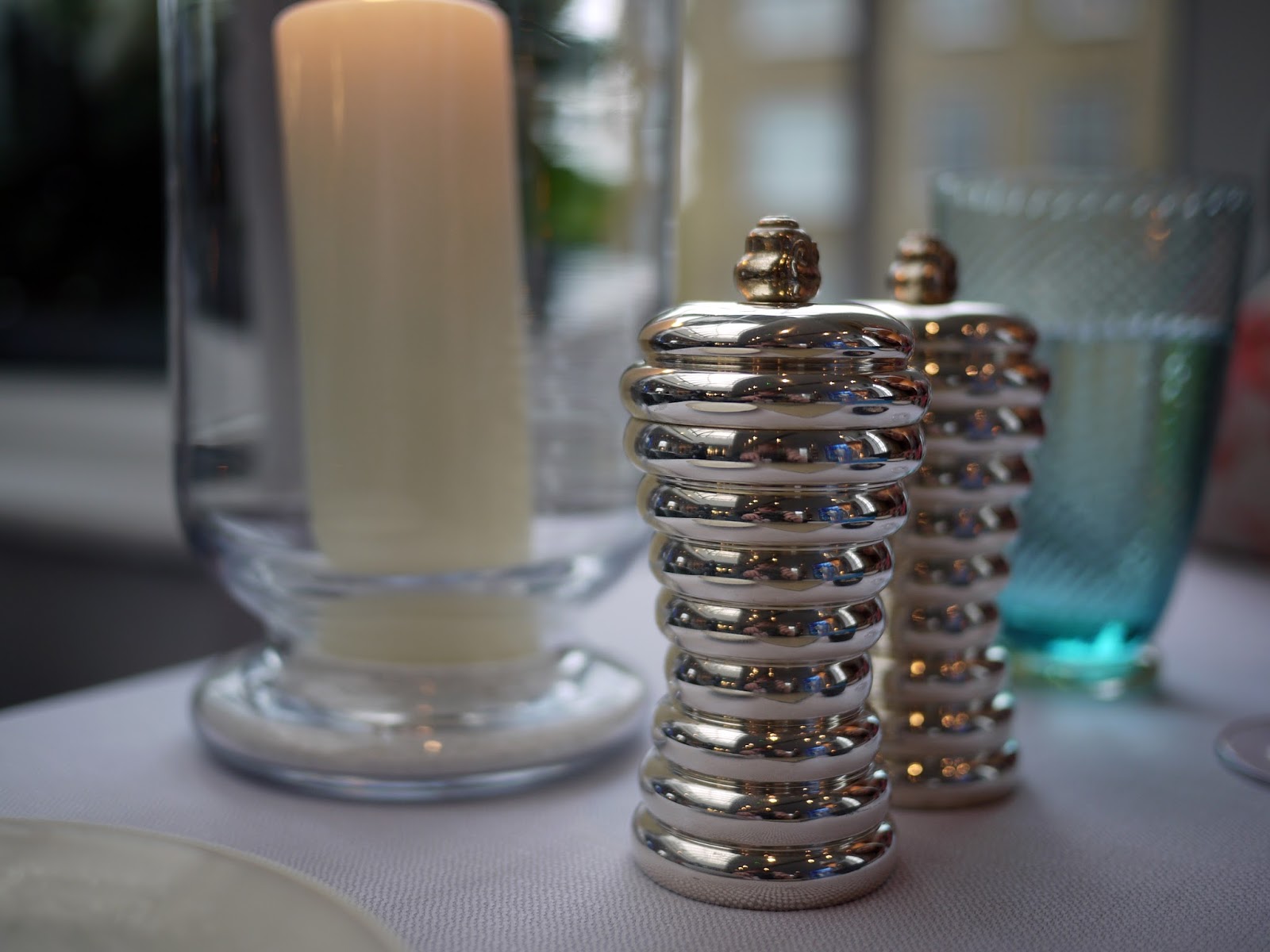
Fortunately, bread was on hand to make up for the coconut pea thing, and not just any bread - sourdough supplied by Hedone in Chiswick. It's become the Done Thing to automatically call this the best bread in London, and indeed at one time it may have been - however the competition is such now that I'm pretty sure I know a few other bakeries that could give them a run for their money. It's still great bread though, and the nice soft butter it came with was superb as well (and even better with a bit of salt on top from one of their weighty silver Bibendum cellars).
It's worth noting that at this point, we still had not been served the first of the 7 courses from the tasting menu. Whatever you think about the merits or otherwise of spending £200 on dinner, there's clearly a lot of work at Bibendum gone into providing extra bits and pieces, amuses and nibbles, and the pacing and style of service had been immaculate. I can think of a few restaurants - and one other in South Kensington in particular - where you could spend at least this and have nothing even so much as a chocolate truffle in addition to the three menu dishes you've ordered. Not so here.
So first course proper, then, was crab with elderflower jelly and sea herbs. This was, I don't mind admitting, the first time I've ever eaten crab and elderflower together, and also (not coincidentally) the first time I've eaten crab elderflower jelly. So perhaps my not being completely bowled over with it is partially the shock of the new. It got better as you dug down and the brown meat mixture at the bottom of the bowl became more prominent, but I still struggled to get past the strange floral/seafood combination. Interesting, but perhaps not an experience I'd want to repeat.
Hibiscus had a good line in asparagus dishes, and so it is here in South Kensington, with this thick meaty spear (sorry, I don't know what came over me), with a strip of confit orange peel and what's described on my menu here as "smoked hay hollandaise" but actually tasted more like a kind of thick hazelnut butter. Very nice, anyway, and I also appreciated the Claude Bosi signature knife that came with it.
It was a nice surprise on sampling this scallops with strawberry "sauce vierge" to discover that the scallops were warmed slightly; there's something about fridge-cold scallop that sets my teeth on edge, and yet in most places that's just what you get. It was also nice to discover that the herby, only faintly strawberry-led sauce that covered them was herby and complex; an attractive, and rewarding bit of seafood.
The next course was an absolute cracker - a beautiful bit of sea bream, geometrically exact with razor-sharp edges, sat on a rich morel and tarragon dressing. The fish itself, with its delicate crisp skin and firm flesh, could not be faulted, and the morel sauce was a classical and comfortable combination of flavours and textures. It's dishes like this that make rather a stronger case for tradition than outright experimentation...
Veal sweetbread, beautifully prepared with a thick, dark glaze of black garlic, was another crowdpleaser. Nothing too strange going on here, just a good slab of offal, cooked perfectly, and a pretty selection of mayonnaisey sauces to accompany it.
Then more veal - Limousin I believe, with a bit of pressed cucumber and a nice rich stock-y sauce. I'm always going to be more of a fan of protein that's been thrown on top of charcoal than teased into uniform pinkness in a waterbath, but it was still a very decent bit of baby cow, not earth-shatteringly interesting but very easy to eat.
And finally, a pea and chocolate cake, which sounds on paper like it might be the most disruptively experimentational dish of all and yet - in the face, it has to be said, of my own personal prejudices (I have a long, unhappy history with vegetables in desserts) - it turned out to be completely brilliant. The pea flavour wasn't jarringly savoury at all, it was just a faint sweet vegetal note, and the sugar levels were expertly judged as to make complete sense of it all. If I only had to eat one vegetable-as-dessert for the rest of my life, then it would have to be this one (though it's true there isn't a great deal of competition on that front).
It would have been easier in writing this post to either be able to make some blithe pronouncement to the effect that when Bibendum stuck to classical techniques and traditional flavour combinations then the dishes were more successful, or alternatively that when they had the courage of their convictions and tried something new the results were impressive. In fact, neither of these extremes are true. In end end, some of the experimentation, such as the pea and chocolate tart, was extraordinarily successful and something approaching an instant classic, while others such as the crab and elderflower, fell flat. And similarly, while the sea bream and morel dish used a tried-and-tested flavour profile to great effect, a rather humdrum bit of sous-vided veal didn't do much for me.
So it's hard to know what to say that's going to be any use really, other than it was all a bit uneven - some bits were great, other bits weren't so great, and it was all rather expensive. Actually, that sounds dismissive - it was, as I said previously, thanks to the huge number of extra bits and pieces, not cynically priced - but I don't want to end up having to use the word "uneven" on any dinner costing upwards of £200 a head, no matter how much fun I had at the time. And if someone came to me with £200 burning a hole in their pocket and asked where they should be spending it, I'm not sure Bibendum in its current form would feature very highly up the list.
But there it is, that's what a meal at Bibendum currently looks like and perhaps in the not so distant future I'll have reason to revisit and it will have really found its feet and become one of London's truly great restaurants. Until then, you're probably more likely to see me at the Ledbury or the Clove Club next time I feel like a bit of haute cuisine; it's hardly Bibendum's fault the competition in London is so fierce at the moment. But how lucky we are that it is.
7/10
Subscribe to:
Posts (Atom)