Showing posts with label Yakitori. Show all posts

Monday, 1 October 2018

Jidori, Covent Garden


After so long writing about restaurants in London, you get used to the pace of change and ebb and flow of things, and accept that there's no restaurant (with the possible exception of Rules) that will be around forever. Mostly, restaurant closures are sad but understandable, victims of a changing market or a shift in focus from the owners. It's a shame that Typing Room is closing its doors but its time had come, and the knowledge that chef Lee Westcott is heading to Worcestershire to open a very interesting looking place in a fancy country hotel, well that sounds like a step up to me.

Of course some closures are more than welcome. Arguments about blameless staff losing their jobs and the state of the economy generally aside, I'm not going to mourn the collapse of Jamie's Italian or Strada any more than I would the cancellation of Brexit - these were bad chains that served bad food and didn't deserve to survive. In fact if Frankie & Benny's, Garfunkel's, Chiquito, Las Iguanas, Pod, the JRC Global Buffet and the Rainforest Café could also go tits up in the next few months I - and the wider world - would be most grateful.

But just occasionally, a restaurant disappears from London that I really, really miss. Bincho Yakitori used to occupy a cosy little spot on Old Compton Street and served the very best yakitori, up to that point (this was before my trip to Japan), I'd ever had in my life. It was informal, and friendly, and served tasty skewers to grateful Soho lunchers for not very much money but what really impressed me about the place was the willingness to offer bits of a chicken I didn't even know you could eat, such as painstakingly-filleted neck, and cartilage. Sure, this more specialist stuff wasn't for everyone, but for a tragic food spod like me just having the opportunity to try something so unusual was very exciting, especially with the added theatrics of being sat at the bar at the open kitchen, clouds of charcoal smoke filling the air.


The most obvious disadvantage that Jidori has, then, is the lack of an open kitchen and bar. The very best omakase experiences rely on that interaction between you and the chef, the immediacy and honesty of the cooking process and the fact the pacing is entirely guided by how fast you want to eat. The pacing at Jidori was admirable, and there's no faulting the friendliness and competency of the staff, who were assured and confident throughout. But would I have been happier sat at an open kitchen swatting away charcoal smoke than in a rather boxy upstairs room overlooking Catherine Street?


Well yes I would, but I would also happily sit in a cupboard in the dark to eat food this good, starting with crackers of puffed corn and seaweed topped with chunks of raw tuna. Seasoned properly and bound with a nice amount of wasabi mayo, these were easily better than the version served at Louie Louie a couple of weeks ago.


Cold roast aubergine is never going to win any beauty competitions but had a lovely flavour, salty and smokey, and dressed in oil. I should say at this point that yes, I know the photos are terrible. Weirdly it wasn't even that dark in there so I don't know what happened other than given my skill as a photographer it's more incredible that any of my pictures are any good at all than some occasionally look like they were taken underwater.


With the snacks out of the way we were on to the main event - bits of chicken on sticks. Breast first, apparently because the Japanese (quite rightly) are so uninterested in the boring breast meat that they want to get it out of the way as soon as possible. These were tender enough though, dressed in a sake and shiso dressing that just softened the bitterness of the charcoal.


Thigh next, neatly rolled and served next to little bits of spring onion, fattier and therefore more enjoyable than the breast, but with that same crunch and smoke from the coals.


Then wing, carefully threaded on the skewer keeping two bones in, presumably to help keep it from drying out. I can count on one hand the number of times I've had a carefully, expertly deboned chicken wing that's not turned to cotton wool from overcooking. If you're very, very clever about it (and I'm thinking mainly of the Chinese style, deboned then stuffed with prawn mince) then you could end up with something worth eating. But most of the time, you're better off leaving the bones in.


So far, so recognisable. Jidori were hitting us with the familiar parts first, the crowdpleasers. But next came the skin, neatly folded into even rows, gently crisped on the grill and satisfying with bags of flavour. I could be wrong but I don't think this was 100% separated skin, I got the feeling there was a slight amount of flesh there too, to bind it together and stop the whole thing becoming overwhelmingly fatty. Very, very good anyway.


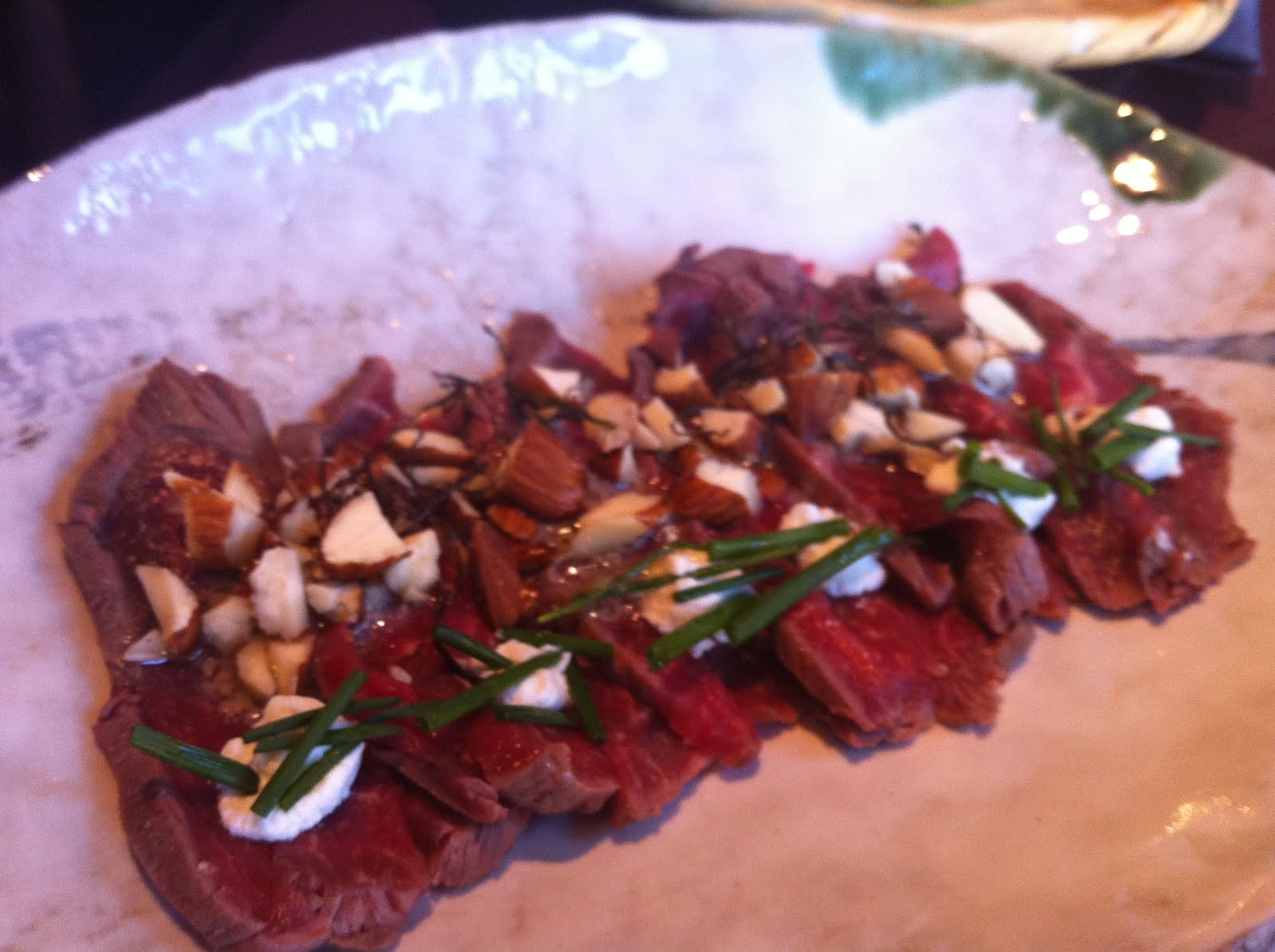
Usually omakase diners have to choose between hearts and liver for the next course - for all their undoubted skill Jidori can't, after all, do much about the composition of a chicken - but with there being four of us we were able to choose both. So here's the liver, soft and yielding and lightly seasoned in some interesting dried herbs...


...and here are the hearts, all bouncy and jolly, with some rolls of crisp bacon to season and contrast. I think heart might be my favourite bit of a chicken overall; the texture is always a delight and the flavour is of rich offal without being bitter or difficult.


Next was what they called 'drumstick', but looked rather more like thigh meat. I think perhaps they'd carefully removed the largest portion of dark meat from the legs and pressed it into shape somehow. Clever stuff.


The next course was more of a surprise - minced chicken skewers, like mini koftas, with a bright egg yolk and soy dressing. We were instructed to whip up the egg and soy into a smooth paste, then dip the mince in before eating. This was great fun, without a hint of the dryness that can affect chicken mince, and very nicely seasoned.


Another unexpected course was this, a bowl containing good soft rice, fresh herbs, some incredibly sour lumps of something citrusy or fruity which I'm going to have to leave unexplained as I can't find anything on Google or the restaurant menu, and all of it in a kind of half chicken consommé half tea broth. If it sounds like there's a lot going on here well you're not wrong, but the flavours all mostly complimented each other (though the citrus element did occasionally threaten to derail things) and I certainly haven't had anything like it before. Also, this was the twelfth individual course of a £30/head tasting menu - extraordinary value for money.


And unbelievably we still weren't done. Coconut water sorbet with elderflower sake was light and refreshing and full of summer flavour, and looked pretty as a picture.


Part of me wonders whether Jidori should charge a little more than the frankly ludicrous £30/head and do the above with some seriously high-end chicken. People are always banging on about those poulet de Bresse that cost £50/pop and I bet if anyone could make the most of them Jidori could. But then, having said that, I once spent £50 on Poulet Dimanche at Hélène Darroze at The Connaught (it's now an eyewatering £90) and the chicken itself was a bit dry and disappointing. So perhaps Jidori do know what they're doing after all.


Anyway, what a way to spend £30. Or rather, what a way to spend £62.50 but there's no need for you to go quite as crazy on the booze as we did. Yep, that's a bottle of wine each. I'm not proud of it. But if you can't spend double the food bill on booze in Covent Garden on a Friday night with a group of old school friends who are all turning 40 in the next few months, well, when can you? The road to my own significant birthday starts now, and Jidori has got it off to a cracking start. Bincho Yakitori is dead*. Long live Jidori.

8/10

*Bincho Yakitori is not dead. They moved to Brighton and by all accounts are doing a roaring trade. In fact we tried to get in a few weeks ago and they were full. The bastards.

Thursday, 10 January 2013

Wabi, Holborn


There's very few times I feel more self-consciously clueless about food than when I'm eating in a Japanese restaurant. Sure, learning the ingredients and preparations in any foreign culture can be a challenge - I'll die happy the day I can order dim sum and not feel like I'm playing a scratch card - but Japanese food is surely one of the most advanced and perfected cuisines on the planet, and comes in such a variety of guises learning even the basics can seem an impossible task.

For a start, there's rarely anything so straightforward as a "Japanese restaurant". Instead, there are udon bars, ramen bars, yakitori joints, sushi bars, okonomiyaki, kaiseki, Brazilian-fusion and probably a few others I'm yet to discover. The intense skill and focus needed to perfect each of these styles of food results in extreme specialisation, and anywhere brave enough to attempt more than a couple of them at once is setting themselves up for a fall.


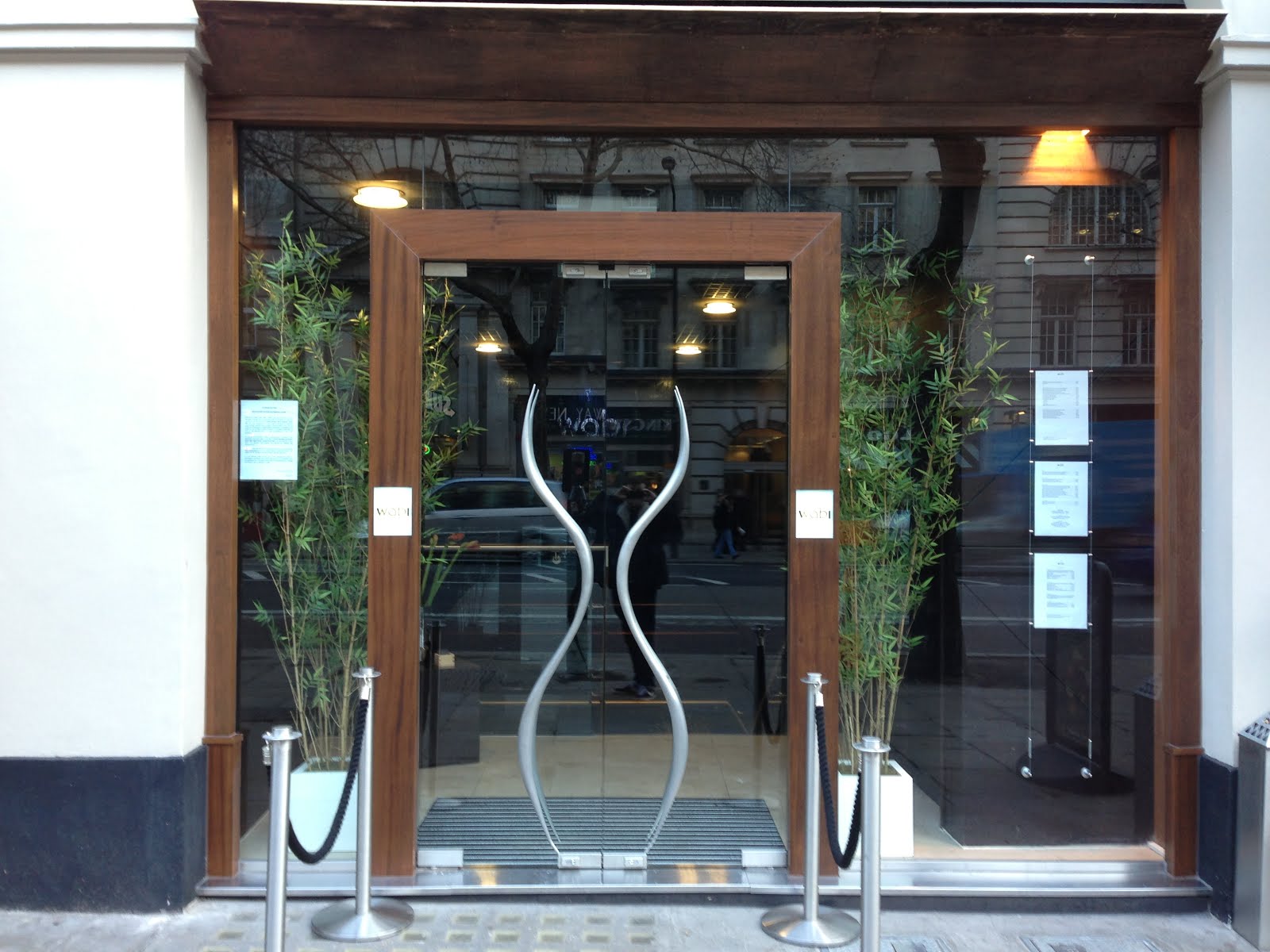
If anyone can have a decent bash at a pan-Japanese restaurant though, it's a former Nobu head chef. Nobu, whatever you may think of their showy, A-list bait restaurants and eye-watering prices, always knew how to produce decent food, and Scott Hallsworth has worked in their kitchens in various glamorous locations all over the world for over a decade. The influence of the mothership doesn't just extend to the food, either - the vast basement space on Kingsway is nicely done, the gently spotlit black wood tables and cream banquettes giving a ever-so-slightly bland but familiar Mayfair vibe, and all front of house being very smart and smiley.


Miso soup was, well, Miso soup, but had a couple of shimeji mushrooms bobbing about in the broth to liven things up a bit. I quite liked that they didn't even offer the option of a spoon so I didn't feel too self-conscious loudly slurping it directly out of the bowl.


I'd ordered a single piece of otoro (fatty tuna) sashimi just to see how their raw skills were, and it wasn't bad, but nowhere near as good as the one from Sushi Tetsu a few months ago and just felt slightly less-than-perfectly-fresh. Also, despite sternly being informed on the menu that the sashimi was "not served with soy sauce", it arrived with, er, a little bowl of soy sauce and a specific instruction from the chef to dip the fish in it. Which was a bit odd.


The BBQ grill set, though, was just lovely. Skewers of soft sliced onions dipped in a powerful miso dressing, delicately boned chicken wings with a perfect crispy skin, a good dollop of powerfully-smoked aubergine salsa, and the most wonderfully cooked (if slightly underseasoned) lamb chops that were just so addictively tender I stripped them clean to the bone in seconds. The sesame-ponzu dressing was a great and time-tested match to the charcoal-crisped protein, and a blackened half of lemon topped it all off. The kind of food that, unless you were a vegetarian or had some other kind of eating disorder, you could not fail to appreciate.


Any criticisms, then, will be largely due to one thing - the prices. It is very easy to spend a lot of money in Wabi and not have a great deal to show for it, and I say that having enjoyed the food there very much indeed. With a (bitterly sharp, presumably a mistake of some kind - it tasted they'd forgotten to sweeten it) salad, some decent pickles and a bowl of rice my fairly modest lunch came to £27, and though I'd happily pay it again, Bincho Yakitori in Soho does better (and cheaper) skewers, Asakusa in Camden does better (and cheaper) sushi and although I didn't try their tempura if it's any better than Koya's I'll eat my kimono.


But for an area that's hardly blessed with great restaurants and for doing what it does with a good amount of style and flair, Wabi is worth a visit. Die-hard foodies will be put off by the very anti-2013 lack of extreme specialisation, but I can only see it getting better as the staff and kitchens bed in, and you'd have to be a real contrarian not to be won over by almost everything about the place. For better of for worse, it's Holborn's very own Nobu.

7/10

Wabi on Urbanspoon

Friday, 29 June 2012

Sticks'n'Sushi, Wimbledon


Wimbledon used to be the place that restaurants went to die. It's strange how the smartest areas of town seem to suffer from a dearth of decent eating options; look at Hampstead, for example, with its couple of half-assed gastropubs and a Gaucho Grill, or Knightsbridge & West Brompton where people go to see and be seen eating salad. You'd think that where the disposable income goes, good food would inevitably follow but the opposite seems to be the case; where times are hard, and incomes low, restaurants fall over each other to offer great value and a great time. In areas that they don't have to try to turn a profit, well, they don't.


Thank heavens, then, that Wimbledon finally has a restaurant worth the trek to SW19. I don't mean Sticks'n'Sushi of course, oh no - that wouldn't be worth anyone's Zone 3 Oystercard supplement. I mean the Lawn Bistro, up the hill in Wimbledon Village, which opened a few months ago and is serving classy, starry dishes for a very reasonable amount of money and which I enjoyed very much. I may one day get around to reviewing it, but in the meantime Hugh Wright has, as usual, said everything worth saying about the place on his blog and I urge you to go read it.


Anyway, to Sticks'n'Sushi. The ninth in a chain, though the first in London (all previous branches are in Copenhagen), it presumably has plans to expand even further so quite why they've chosen Wimbledon for their flagship is unclear. Perhaps it has something to do with the huge space required for their "concept" - a massive open kitchen consisting of rows of gleaming workstations and looking like the set of Iron Chef. It's certainly impressive, and the rest of the room is attractive in a sort of chainy way even if it did remind me rather disturbingly of the inside of Fire & Stone in Covent Garden.


But my heart sank when I saw the "menu". Rather than have anything so pedestrian as a sheet of paper with available dishes listed on it, Sticks'n'Sushi prefers you rifle through a glossy catalogue of artfully photographed seafood, with barely more than a couple of dishes per double-page for extra annoyance, and the odd box of smug 'sustainability' guff. Even more incredibly, there are two of these catalogues, one containing A La Carte and the other a number of suggested "meals" with irritating names like "Salmon, duck and his friends" and "Mixed emotions". It's almost impossible to settle upon anything though because by the time you've reached the last page of this Littlewoods Catalogue of Food you've completely forgotten what came first. It's pointless, and annoying, and so in a desperate attempt to cobble together some kind of variety between the two of us we ordered a few bits of sashimi and a few yakitori and hoped for the best.


The food, on the whole, wasn't all that bad. Some "blini" (not very Japanese I know, but they were a special suggested by our waiter and rather than to have to plough through that menu again we agreed to have them) were on the bland side but still had enough nice fresh fish and crab to be worth the effort. Sashimi (tuna, salmon and yellowfish) was nicely presented on a pile of ice but were only middling-quality as you can probably tell by the rather mean strips of fat in the salmon. And beef tataki threw some interesting textures together, and was particularly enjoyable dipped in the goma dressing it came with, but was fairly low quality cow.


Elsewhere, "ebi bites" (deep fried prawn things in batter) were soft and greasy and drowning in mayonnaise, tuna yakitori was overcooked to dry grey, and chicken tebasaki (wings) managed somehow to be bland despite being incredibly overseasoned. Nothing was hideous, or even inedible, and I can think of certain things I would even like to try again amongst the whole load of stuff that I certainly wouldn't, but overall this was mediocre Japanese food, all style and no substance, glossily presented but lacking heart.


Which is what you might expect from a chain, and it's still not the worst Japanese food I've eaten in London (Yo! Sushi has few rivals in that department), so why is there no chance of hell I'd ever go back to Sticks'n'Sushi? One reason and one reason only - the stupidly high prices. Our meal, with a couple of cocktails and a £20 half (half!) bottle of sake came to £112.16. Luckily for us (if not them), this was a PR invite, but this is about as much as you'd pay in Roka on Charlotte Street, where the flashy presentations are matched by real skill at the stove, or even at Sushi of Shiori where £50/head will buy you two hours in the company of London's most talented Japanese chef. It's cheaper than Umu perhaps, or Yashin, but for heaven's sake this is a chain with chain ambitions, not a boutique omakase sushi bar. It's simply not worth this amount of money.


But don't worry Wimbledon, you still have the Lawn Bistro. And don't worry the rest of London, because there's no need to travel to SW19 for good sushi, you can go to anywhere above as well as Asakusa in Mornington Crescent or Ten Ten Tei in Soho. And for great yakitori, as well as Roka there's the wonderful Bincho on Old Compton Street, which regularly offers a thrilling range of things on sticks for very little money indeed. I'm not sure what it says about the standard (and cost) of food available in Cophenhagen that SnS is so wildly popular over there, but we have no need for another mediocre Japanese chain over here thank you very much. One is more than enough.

4/10

Sticks N Sushi on Urbanspoon

I was invited to Sticks'n'Sushi

Friday, 3 June 2011

Cheese and Biscuits On Tour - Japan


It's not so much culture shock as culture electrocution. From the moment you arrive in Japan, you are subjected to an overwhelming, indecipherable barrage of population and neon and noise; of train stations like underground cities that stretch for miles in every direction; of restaurants piled on top of restaurants piled on top of shops, squeezed into the most impossibly tiny cracks between impossibly tall buildings; of Zen gardens, raked gravel and the gentle fog of incense; of frantic activity and astonishing order; of service polite to the point of humbling, a thousand variations of smiles and nods and bows that makes human interaction in this most overpopulated of societies not only possible but a constant, life-affirming joy. There aren't enough words in the world to describe just how much it all is, just how much Japan there is in Japan. It's civilisation squared. It's also completely wonderful.


But I imagine you're here to read about the food. Needless to say, at 3 meals a day for two weeks, I will need to be more than a little selective about what to write about, which, considering nearly everything I put in my mouth was interesting in one way or another, is not going to be easy. But like Japan itself I can only hope I can create some kind of narrative out of the chaotic jumble of holiday photographs and sake-sodden tasting notes, and I'll try my best to not get anything too horrifically wrong.


Getting things horrifically wrong, in actual fact, was the one thing I was most terrified of before I landed in the country. Having heard all kinds of stories of complex social rules of engagement, and the numerous seemingly innocuous ways in which a clueless Westerner may inadvertently break them, I spent my first few hours desperately attempting not to offend anyone. I had read somewhere that blowing your nose in public was a no-no, and when the bright Tokyo sun hit my jetlagged eyes and caused my nose to run, I locked myself in one of the many pristine public lavatories in case someone saw me empty my sinuses, contacted the authorities and cancelled my visa. Of course, this turned out not to be true, as a brief but enlightening trip on the JR line amongst a cacophony of sneezing and snorting commuters soon demonstrated.


A bowl of udon in Ueno station (nice and messy, ¥700 ish) and a J.S. Burger in Shibuya aside (¥900 but look, they had free WiFi, OK?), my first proper meal was at Yotaro, a tempura restaurant in Roppongi Hills, organised through the magic of Twitter, the kind intervention of @legbye and a very helpful contact on the ground in Tokyo. You'd think that, armed with a name, a location, a superfast hotel internet connection and a set of detailed instructions from the nearest tube, finding it would be reasonably straightforward but, this being Tokyo, I spent half an hour stalking the alleyways of Roppongi asking in every building that looked like it might sell food until eventually I called my contact, had him call the restaurant, and the chef came running out into the street to find me. Turned out I had walked past it a number of times but assumed it was someone's house. Japanese restaurant signage is very discreet.


The meal was fantastic. Starting with grilled conger eel in miso, followed by beautifully-presented sea bream sashimi with the most incredible yuzu/ponzu dipping sauce, the tempura tasting itself consisted of at least a dozen items - "shrimp sandwich", prawn, whiting, squid, lotus root, Japanese peppers which bore a remarkable resemblance to Padrons, mushroom, aubergine, and another prawn - each fried to order and brought out one by one with instructions to eat them first dipped in salt. Then a whole sea bream was baked in rice and meticulously filleted using chopsticks and presented with a little tower of bouncy pickles and a great clear vegetable broth. I had been told that Yotaro was awarded a Michelin star in the famously star-heavy Tokyo guide and I couldn't resist asking the chef (who spoke excellent English thank God) if this meant anything to the Japanese. "Not really," he replied, "but for a while we had a few more foreign visitors." A land where Michelin means next to nothing. My kind of place.


And so, collecting a couple of members of my family along the way and boarding the bullet train from Tokyo station, to Kyoto. Where Tokyo was impressive in a dazzling futurist kind of way, Kyoto is refined and elegant and effortlessly beautiful. It is a city of ancient temples and ancient lantern-lit alleyways populated by silken geishas and sharp-suited salarymen. The food market was endless and endlessly fascinating; we gorged on fresh fried chicken thighs and a selection of interesting pickles, none of which I could pick out of a line-up, and ate bright red baby octopus, the head stuffed with a quails egg. That evening we climbed a rickety wooden staircase in an anonymous ramshackle backstreet to a sushi restaurant, and ate uni nigiri washed down with copious amounts of house sake. One little custom I very much approved of was the tendency to serve sake in glasses stood in a high-sided saucer, and then to overfill the glass so the sake fills both the glass and the saucer to the brim. Or maybe I just like lots of sake and don't care which traditional Japanese custom I can use an excuse.


Lunch on one of the Kyoto days was, and I'm guessing will forever remain, one of the most unbelievably beautiful places I've ever enjoyed a meal; a steep-sided, moss-covered mountain gorge framed a series of crystal-clear waterfalls, over which were suspended wooden platforms holding tables and cushions (this, like most of the poshest Japanese restaurants, was a cross-legged affair). To the sound of running water and under bamboo shades hung with paper lanterns, we ate exquisitely presented sushi; local vegetables, whole deep-fried river fish, silky sashimi and more of those bouncy, sweet pickles. It was one of those moments so ethereally magical it's hard to believe it happened at all - I can hardly even believe the photos.


But I'm not going to pretend that every moment of every meal in Kyoto or elsewhere was that easy. In my own arrogant bloggery way I assumed I was sufficiently battle hardened to unusual ingredients and textures to be able to casually throw down my neck everything coming my way in Japan. In fact, oh so naively, I initially relished the opportunity to challenge myself and for the first couple of days actively sought out anything that looked like it might not go down without a fight. I'm not sure when exactly the last of that confidence was completely crushed; perhaps with a shockingly bitter whole fried fish in a multi-course foraged menu in Kyoto which was like swallowing a mixture of soil and bones; perhaps with an entire, raw baby squid I blithely assumed was marinated or treated or something (I mean come ON) only to have the poor recently deceased thing burst in my mouth like a bag of fish guts and provoke a swift but decisive reaction from my oesophagus; or perhaps it was the warm cod's sperm. Yes, probably the warm cod's sperm.


The thing to remember, of course, is that while the occasional dish or ingredient was challenging or, yes, sometimes downright revolting, the experience of eating the meal in such special circumstances - inevitably gracious service, stunning interiors (the Japanese must be the world masters at interior design, everywhere we ate looked like it was from the pages of a glossy magazine) - meant that you always came away satisfied. Occasionally though, a restaurant would test my good will to the limit. One night in Kyoto, in yet another effortlessly pretty, lantern-lit restaurant hanging over a quietly flowing canal, we were presented with a harmless-looking bowl of spinach/egg roll, a pretty selection of seasonal vegetable and edible flowers, topped with what looked like a lump of fish mousse of some kind. The waiter explained, in Japanese, the ingredients (fortunately we had a translator with us by this point), said translator (actually my brother-in-law's brother who has lived out there for nearly four years now) passed on what he thought we needed to know, and I merrily scooped up all of the "fish mousse" in one go and swallowed it. Try and imagine, yes, a fish mousse, but one that has been made from last year's catch and left in the sun for most of the time in-between to gather flavour. It tasted like no food should ever taste, grimy and funky, with the texture of porridge and the inescapable musky notes of fish sex.


"What the hell was that?" I gasped as, somehow, mercifully, the last of it wobbled down into my stomach.

"Oh that's cod's sperm. I didn't want to say anything in case you were squeamish. I don't like it."

I didn't much like it either. In fact, I'd go so far as to say I found it pretty bloody disgusting. I also didn't like the fact it reminded me of its presence in my gut every time I attempted to wash away the taste with a swig of bland Japanese lager. Still, I guess that's what's known as a Life Experience.


After the always entertaining but occasionally terrifying experience of eating out in Kyoto, Osaka seemed much more my cup of tea. The city is known for Takoyaki, fried balls of octopus meat in thick batter, often dressed with brown sauce and mayonnaise and always, always delicious. We came armed with lists of recommendations for the "best" Takoyaki but quite honestly, everywhere we ate, from the most unpromising city-centre tourist trap to a standing-room-only streetside stall, was never less than excellent. An average-evening's restaurant hop also often involved a serving of Okonomiyaki, a sort of pancake containing meat and veg and basically anything you fancy. Cooked on a hot plate built into the table, coated in more of that sharp brown sauce and mayonnaise and squirling bonito flakes, it's a theatrical, hugely enjoyable way to eat and we made the most of every opportunity.


More high-rise and less beautiful perhaps than Zen-like Kyoto, though no less interesting for that, Osaka was probably my favourite stop in Japan. The Shinsaibashi shopping area was continually interesting, every restaurant or stall seemed good and friendly enough to spend the day in, and despite the fact that hardly anyone spoke English (even fewer than in Kyoto, which is saying something), accomplishing anything seemed remarkably easy. One night we found ourselves in the suburbs eating the greatest ramen I think I've ever had in my life, accompanied by a dozen crispy gyoza dumplings, and yet I didn't get the impression this particular ramen joint was a destination or better than any number of other places. The minimum standard of eateries in Japan is simply astonishingly high; it is no exaggeration to say you will eat well (if you have a strong enough stomach) anywhere, something you can't say about many countries. And even if you don't eat out, the supermarkets and department store food halls are a wonder in themselves. Where else has a single melon on sale for £100, and yet in the same room two thick chunks of unbelievably marbled Wagyu steaks for £15? I indulged myself one night towards the end of the trip - because I'm worth it - and cooked up a couple in a friend's flat. They were, of course, superb.


There's a lot more left to be said. This continually enthralling country will resist all best efforts to summarise it sufficiently - I wanted to talk about silky udon in Shikoku, the breathtaking Imperial Villa in Kyoto, cold soba for lunch, fish ice-cream, fermented sushi that tasted like blue cheese, pork shabu shabu in Shinjuku Tokyo - but perhaps I should call this post before long-winded spills over into self-indulgent. You can click here and here to see the rest of the photos I took on the trip, and there are even a few shaky videos here if you don't suffer too badly from seasickness (or haven't just "enjoyed" a dish of warm cod's sperm). Now I'm back in the UK, nursing my broken bank balance and surrounded by the pile of anthropomorphised snacks I swept into my carry-on luggage in the 7-11 at the airport, memory has only served to gold-plate my experience in Japan, to frame and polish and mount it as one of the great journeys of my life. Perhaps you only really enjoy a moment once it's passed. Unless, that is, the moment in question involves warm cod's sperm.