Friday, 25 March 2022
Noci, Islington
Theoretically there's no reason why there couldn't be an exciting, modern mid-range Italian restaurant in every corner of London. If the wild successes of Padella and Bancone have taught us anything, it's that Londoners love a good fresh pasta dish, and are more than willing to join a long and slow queue in whatever inclement weather the city decides to throw at us, as long as at the end of it we can enjoy a nice plate of cacio e pepe and an Aperol spritz.
However, as you may have noticed, there isn't an exciting, modern mid-range Italian in every corner of London, and genuinely accomplished (and affordable) pasta dishes are few and far between. For every Padella with its exquisitely tasteful and masterfully constructed take on the classics, there's a Norma, their bull-in-a-china-shop attitude to ingredient combinations yielding some pretty distressing results. And for every Bancone, whose striking silk handkerchief pasta topped with egg yolk became an instant classic as well as a genuine sub-£10 bargain, there's chain rubbish like Carluccio's, clogging up our high streets with soggy linguini and overpriced deli tat.
Noci is neither as bad as Carluccio's, nor as good as Bancone, which makes the job of reviewing it rather difficult. It's not that any of the dishes were inedible, they just weren't particularly memorable either, and all the while you get the very strong impression of a solid, well-meaning kitchen attempting to tribute-act their way to success without quite grasping what made the original (the head chef is ex-Bancone) work so well. Take the focaccia, for example - perfectly nice, just not quite enough texture or salt or flavour, and I'm not sure dumping a handful of cold stewed onions on top really achieved much.
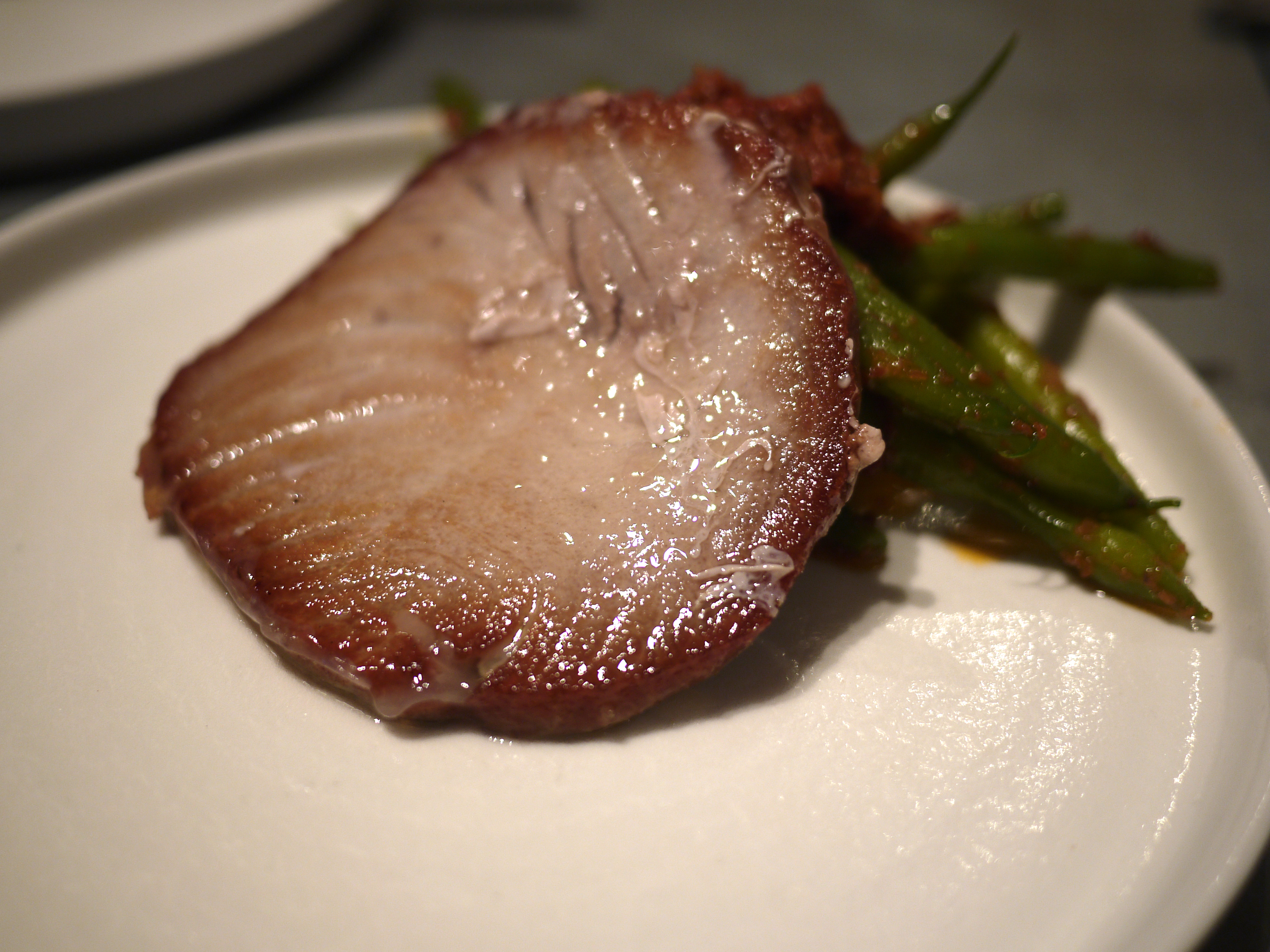
Seared tuna steak was, well, fine - bit underseasoned and a tad on the dry side but not too bad. I'm not sure the runner beans did enough of interest to provide a proper accompaniment, and the salsa they were topped with appeared to be not much more than chopped sun dried tomatoes, but it was just about worth the £9.50.
Fried squid were much more my kind of thing - greaseless, nicely seasoned and served with a little pot of bagna cauda. If I'm going to be brutally honest the bagna was a little bit too fatty and without quite enough of a hit of anchovy, but it was still a better starter than the tuna.
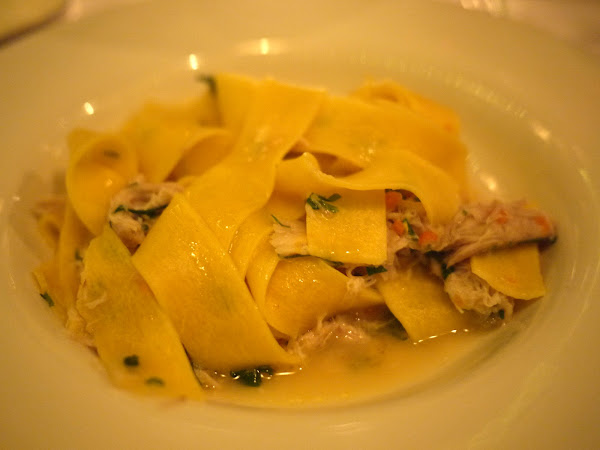
We were soon onto the pasta dishes though, all arriving at once which was quite slick of them. People are bound to directly compare the silk handkerchief pasta here with the Other Place, so I might as well too - Noci's isn't as good. In Bancone the dish is a masterclass of cool understatement, beautifully arranged fat flowers of pasta glossy with walnut butter surrounding a single egg yolk. The Noci version was carelessly presented, the two different shades of pasta confusing the eye (I thought the darker ones were mushrooms until I looked closer) and scattered underseasoned funghi doing nothing but distract from the (decent) pasta. The nice bright orange Burford Brown egg was an upgrade though, so I'll give them that.
This was on the menu as "Cacio e pepe bigoli", but the eagle-eyed (and the recently-returned-from-Verona - me) amongst you may have spotted that these aren't bigoli, but in fact bucatini. Perhaps they thought we wouldn't notice. They were OK, but the flavour was quite subdued and the pasta had a strange tackiness, and was nowhere near as good as the heavenly version at Padella.
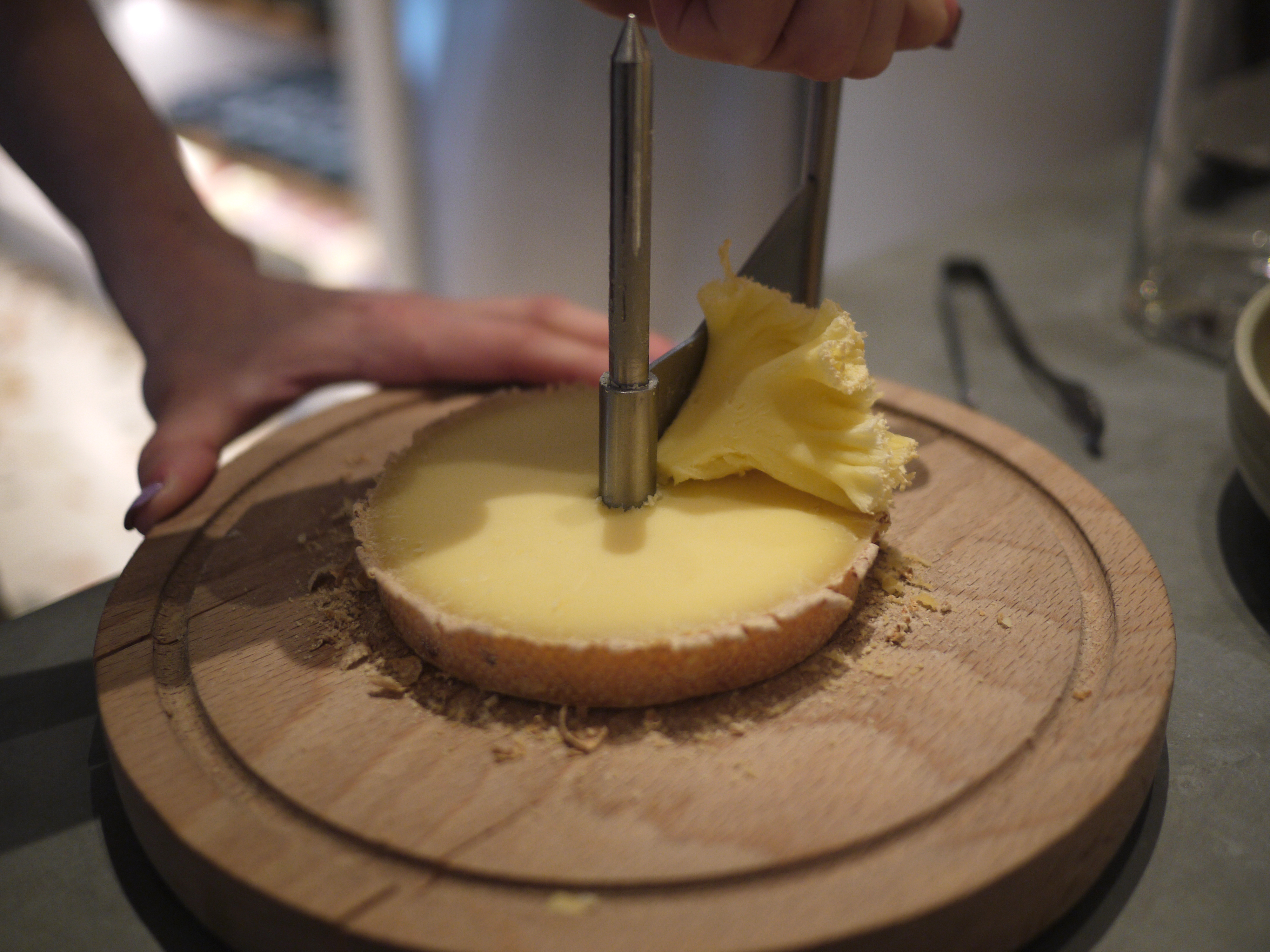
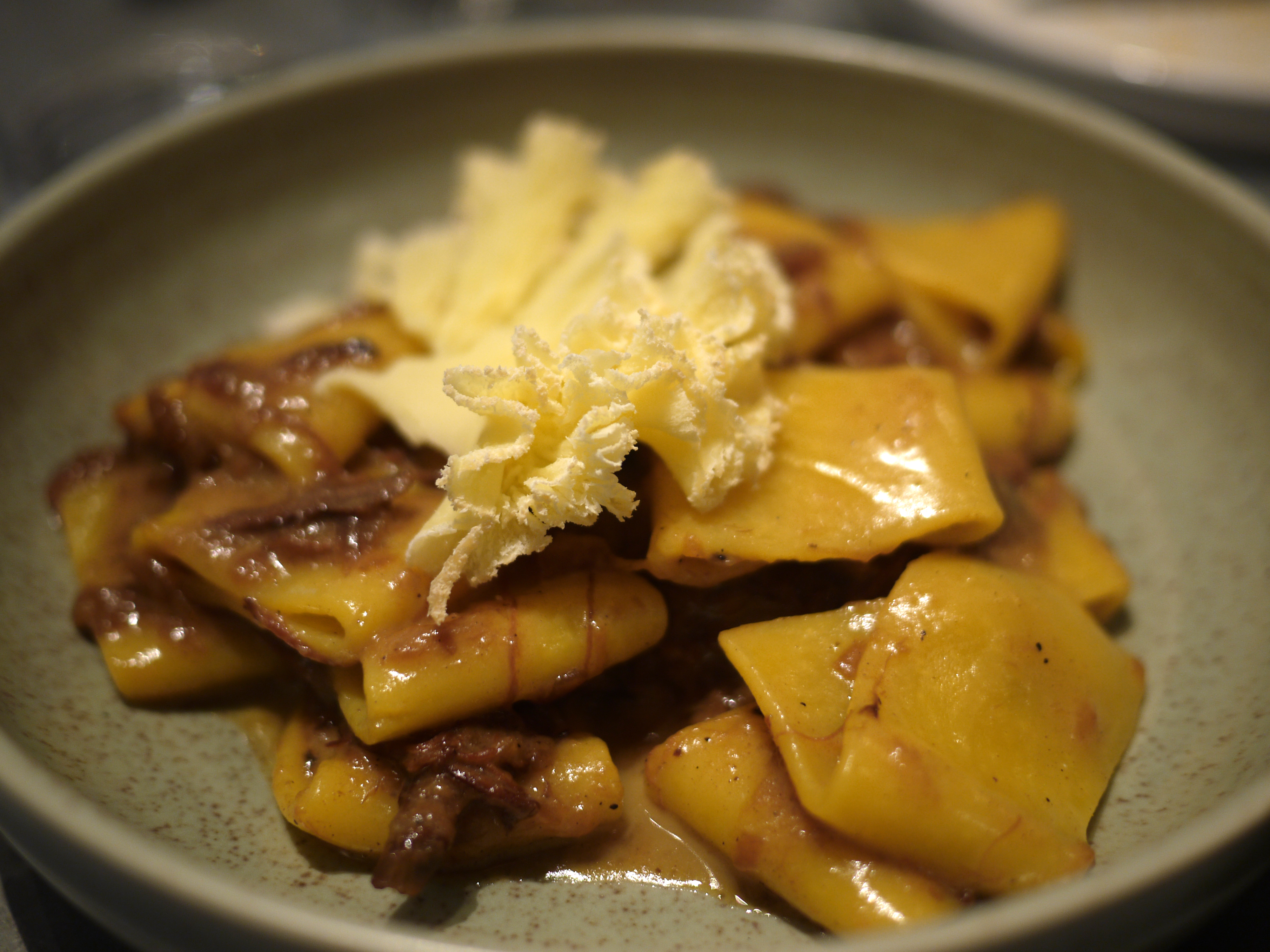
Veal & pork ragu was rather unpleasantly sweet, possibly from too many aggressively caramelised onions - in fact it was my least favourite of all of the dishes. There was no real meaty hit, it was all a bit bland and characterless, and the pasta (paccheri) had the same cloying texture of the buccatini. Not particularly nice, I'm afraid. Also, although TĂȘte De Moine is perfectly nice in many other contexts, the Italian I was eating with had more than a few words to say about the logic of topping an Italian dish with Swiss cheese, let me tell you.
Much better was lamb open ravioli, which not only had perfectly constructed pasta and lovely rich lamb but, somewhat against expectation, the addition of chive oil not only brought beautiful highlights of shimmering green but also a genuinely interesting extra herby note, really complimenting the meat. One of the more successful dishes, this one.
And lastly, seared scallops, nice in of themselves despite needing a bit more of a crust, but on a bed of pappardelle in cavolo nero sauce so utterly devoid of flavour - despite plenty of pancetta which may as well have been fried cardboard for all the seasoning it provided - that we were finally compelled to ask the front of house for some salt. It helped, but this was still a pretty underwhelming dish, and at £16.50 the most expensive item on the menu.
There were, in the end, bits and pieces to enjoy at Noci. But it all felt like a bit of a tribute act, and much as I can enjoy a tribute act, the fact is, the genuine article is still out there wowing the crowds for about the same amount of money and slightly more style. Eating at Noci is the culinary equivalent of a Bootleg Beatles concert - you have to admire the technique and the effort involved even if the result is ultimately no more than four slightly squishy middle-aged men jiggling about in ill-fitting suits and silly wigs. Only with pasta.
With a bill of £40 each with only a glass of wine, it wasn't back-breakingly expensive, just very slightly pricier than elsewhere, and not as good. And I'm afraid there's no real way of framing that as a recommendation. Of course this being London you can pay a lot more for a lot less, but I don't think it's unreasonable to expect a thrusting new Italian restaurant in Islington to be aiming a little bit higher than adequate, let alone to live up to the promise of its pedigree. Life's too short for boring pasta.
6/10
Wednesday, 16 March 2022
Cascina della Taverna, Desenzano del Garda
One of the best things about visiting food-obsessed friends in a foreign country is that - if you're lucky - you generally get taken to the best places without having to put much of an effort into the decision-making process yourself. And often, after a wonderful meal in the middle of nowhere, you get driven home without having to worry about taxis or late-night trains. This is all, clearly, to the good.
The one teeny downside, though, is that taking such a back seat on planning this meal at Cascina della Taverna, I quite shamefully a) did very little research on the place beforehand, and b) even now couldn't tell you exactly where it was on a map without cheating and using my iPhone picture history. All I knew, as we arrived at this remote farmhouse somewhere over the border to Lombardy, was that it was a family-owned restaurant that specialised in steak cooked over a wood fire. And to be quite honest, that's all I needed to know.
The first indication that this place took their steaks very, very seriously was a menu that boasted a pretty comprehensive selection of cow not just from the local area but from as far afield as Poland, Ireland and Germany. I'm don't know if you've noticed but the Italians are famously, to the very last one of them, almost psycopathically protective of their national cuisine, and for a cut of Hereford beef from Ireland to find its way onto the menu of a restaurant in Lombardy, presumably risking the ire of the locals, is quite a statement of confidence in its quality.
However, I didn't come all this way to eat Irish beef. Instead, I thought I'd start with some horse. In this case, carpaccio, lightly seasoned with salsa verde and drizzled with olive oil, with a lovely firm-but-biteable texture and an interesting gamey flavour somewhere between venison and steak. I'd eaten horse before (not least a fillet steak we cooked in Verona a few days before) but never carpaccio, and it was a genuine revelation how well it worked instead of the usual beef.
But nice though the horse was, I was here for one reason only. And that was a giant Fiorentina steak, dark and crusty on the outside and just touching room temperature in the very centre, cooked in their beautiful wood-fired hearth, in the true Italian farmhouse style. From the list of options I'd decided to go as local as possible, so this Barbina Franciacorta came from, as the name suggests, Franciacorta which is a wine making region just further north west past Brescia. And of course, it was everything I hoped it would be, a masterclass in live-fire technique matched with expert animal husbandry and the usual Italian obsession with finish and quality. Just look at the way that crust glistens, and how dark and rare the meat is next to the bone. Utterly brilliant.
We may have eaten some other things, I can hardly remember. The thing is, I was so far out of my usual blogging mindset I barely remembered to take a photo of the food at all, and would have happily just scoffed down my steak, paid up and then been led back to the car and been driven home like a slightly baffled elderly English relative on a rare trip abroad. I think there were some potatoes, and a bowl of greens, probably puntarelle as they seem to have been on every restaurant menu in Veneto that week. I'm sure they were lovely. But I had my steak and that was that.
I think the bill came to about €70 each, artifically inflated (sorry Italian friends) by my stubborn insistence on the full 3-inch thick Fiorentina rather than any lesser costata on offer. I think you can eat at this place for a lot less, or - as is probably more usual - take a few more people with you to share the Fiorentina. But bugger it, I regret nothing. It was certainly the best steak I'd eaten since Extebarri, and it was a damn sight cheaper than that, let me tell you.
There's no doubt, having stayed in Verona with a blogger friend from way back, that I had a slightly exaggeratedly wonderful experience of the food in this part of the world than would have been the case if I'd just relied on my own research or - horror of horrors - just done the usual tourist thing and eaten wherever looked decent on the day. But that said, outside of a few very dangerously glamorous spots in Verona and Venice, I very much got the impression that €20/coffee ripoff joints very much the exception, and for the most part Italian food really just is that good. And for a case in point, Cascina della Taverna, a shining embassador for one of the worlds great cuisines.
8/10
Tuesday, 8 March 2022
You Decide 2022
Right, I've put this off long enough. I can only use Covid as an excuse for so long, and now I'm not wearing a mask on the tube any more there's no reason I can't subject myself to the usual ritual Death by Restaurant. So it's time, after a two year break, for my considerate and well-meaning readership (hint hint) to vote on the subject of my next restaurant review.
Same caveats apply:
1. I can't have reviewed the place before (have a quick Google if you're unsure)
2. It has to be either in London or easily accessible from London (I'll get on a train but I'm not flying to Athens)
3. Please check the restaurant you want to vote for hasn't already been added before you add it yourself.
And yes, I am aware it's more than likely I'll end up going to Nusr-Et, but that doesn't mean I can't start you off with Nathan Outlaw as an option, either. SOLA won last time, so there's always hope. Knock yourselves out.
EDIT: Nusr-Et was, predictably, the winner. I'd better start saving.
Same caveats apply:
1. I can't have reviewed the place before (have a quick Google if you're unsure)
2. It has to be either in London or easily accessible from London (I'll get on a train but I'm not flying to Athens)
3. Please check the restaurant you want to vote for hasn't already been added before you add it yourself.
And yes, I am aware it's more than likely I'll end up going to Nusr-Et, but that doesn't mean I can't start you off with Nathan Outlaw as an option, either. SOLA won last time, so there's always hope. Knock yourselves out.
EDIT: Nusr-Et was, predictably, the winner. I'd better start saving.
Monday, 7 March 2022
Brutto, Clerkenwell
People used to say about Polpo, the game-changing take on a Venetian bacaro founded by Russell Norman and Richard Beatty, that it was "never really about the food". You went for the carefully crafted atmosphere of a canalside Venetian bar, exciting new cocktails (at least to London) like Negronis and Aperol Spritz, and a front of house where piercings, tattoos and beards were not just tolerated but promoted, instead of as had previously always been the case, rendering their owners unemployable. People went for all that, the story goes, and the food was an afterthought.
Initially, this did indeed seem to be the case. I really did not have a good time with the food on my first visit back in 2009, and being a lot more unforgiving of teething problems from a brand new kitchen team back then, gave it a rather grumpy 4/10. However, even then there was something new and exciting about the place - a certain sense that you enjoyed being in that room and watching the rather louche Soho service do their thing, and the fact that so many others clearly thought the same (the queues very soon trailed down Beak Street) meant you felt like some kind of exclusive club, brave new adventurers in this new direction for London dining.
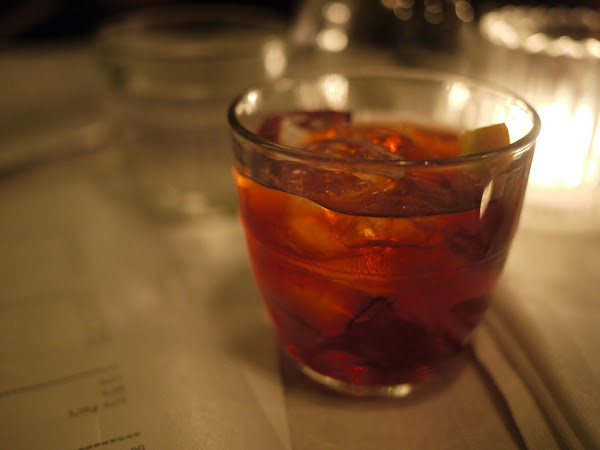
Russell - for he is now un-partnered from Beatty - has learned a lot in the intervening fourteen years, as you might hope he would. Brutto is his latest venture, a pitch-perfect take on a neighbourhood Tuscan trattoria (I can say with some confidence, having been there), with the same eye for interior design detail and clandestine, bustling atmosphere, but - crucially - with a kitchen that right from the start seems to be out to impress. The Negronis, as you might imagine, are a good way to start.
Tonnato is a dish that has to be completely perfect or it's completely disgusting, but fortunately this one was the former. Slices pork replaced the more usual veal, and sliced caperberries provided just enough pickle to cut through the tuna/anchovy (I assume both but who knows) sauce. It also tasted a lot better than my photo makes it look, which goes for everything else we ate that evening. Sorry, it was dark in there.
Anchovies and (lots of) butter is a combination I can always get behind, especially with anchovies as good as these - soft and melt-in-the-mouth - and of course accompanied by St John sourdough.
There's an element of the menu design at Brutto that's more than a little tongue-in-cheek, but there's nothing wrong with that. An Italian friend laughed out loud at the idea of ordering "penne con vodka" in a restaurant in 2022, but it was genuinely excellent with nice big healthy shapes in a rich tomato sauce. Photos are for illustrative purposes only.
Even more exciting was rabbit papardelle, rich and fully flavoured with mysterious herbal notes, the giant folds of pasta glistening with butter. Again my photo does not do it justice, for which I can only wholeheartedly apologise to everyone at Brutto. You sincerely deserve better.
This is not, as first appears, the Creature from the Black Lagoon but in fact (you'll have to take my word for it) an absolutely blindingly good side of puntarelle with some kind of bagna cauda, an extremely addictive combination. Almost everything on the menu is simple on paper but in some way complex and unexpectedly extra rewarding on arrival. Nothing is lazy or ordinary.
Finally, a giant plate of pink roast beef with crunchy roast potatoes. Perhaps it could have done with a sauce, but then maybe that's not the point of Italian steak - I seem to remember not getting one with my Fiorantina in Veneto a couple of weeks back. Anyway the beef was lovely, and the potatoes crunchy on the outside and full of personality.
The bill came to about £60/head, or at least would have done had they not knocked a couple of negronis off, so thanks very much for that. But either way, it seems about the right amount of money to pay for a dinner like this, pretty much equivalent to the cost per head in Polpo back in the day (adjusted for inflation) and let me tell you, this food is an order of magnitude more accomplished than that (at least in the early days).
We've come a long way, the restaurateurs and restaurant-goers of London, both. We've suffered through worldwide recessions and repeated miserable lockdowns, we've followed new directions and new concepts, mourned the closures and cheered the re-openings. But for as long as somewhere like Brutto can spring into existence, survive and thrive - and blimey it's hard to get a table - there's a chance there are, in fact, more reasons to be hopeful than not. Brutto, then, perhaps not as gamechanging as Polpo, but much more accomplished. And I know which one I prefer.
8/10
Monday, 28 February 2022
The Princess of Shoreditch, Shoreditch
My first job in London after moving down in 2003 was in a small basement office on Wilson Street near Finsbury Square. On my first day, a Friday, the boss announced at 1pm that everyone would be going to the pub for lunch, where he ordered, over the next couple of hours, a good few pints of lager each and plates of chips. At some point mid-afternoon he half-heartedly suggested we return back to the office, where we drunkenly squinted at our screens for about 30 minutes until he decided, at 4pm, it was hometime. This, I thought at the time, was the kind of work attitude I could get behind.
That pub, our office local for many years, was the Princess in Shoreditch - even then, I think my memory serves me well enough to say, making a name for itself serving elevated gastropub food. Today, the place at first glance looks very similar to how it did almost 20 years ago, although I don't remember them serving Shoreditch Old Fashioneds (coffee-infused Buffalo Trace, Angostura, orange) in 2003. Downstairs the menu is of attractive, keenly-priced gastropub stuff like crab cocktail and beef wellington, and I'm sure it's very lovely. But on the first floor, reached via a precipitous spiral staircase, some real magic is happening.
Upstairs at the Princess of Shoreditch is where they serve their tasting menu - think the full Moor Hall experience to downstairs' The Barn. It is one of the capital's more ambitious menus, a £75 set composed of 11 individual dishes beginning with "Snacks", dainty little toasted cheese finger sandwiches, artichokes topped with crab, and clever salmon truffle things encased in a delicate layer of some kind of solid fat topped with chervil, which melted in the mouth quite wonderfully. The snacks were in fact quite reminiscent of those at the sadly-departed Greenhouse Mayfair, another place that liked to stretch its muscles in these kinds of cheffy directions.
Bread was a sourdough, a brioche, and - my favourite - salty seeded crackers which were worryingly easy to eat. There were two types of butter, too (no self-respecting restaurant can serve any less these days), one very potently truffled and another simply whipped.
Of all the dishes, though by no means a disappointment, "Sweet onion" is the only one I could really think could be improved. All the flavours were slightly muted, not least the onion soup itself which needed a lot more kick, and I could have also done with more of a hit from the little blobs of Keen's cheddar mixture dotted around inside the bowl. However - and it's a big however - this course arrived with little homemade potato chips, salt and vinegar-flavoured with - incredibly - a single sprig of chervil somehow incased within each one, like a prehistoric fern preserved inside a sliver of amber. I don't know how difficult these are to make, but I'm going to assume it's not easy, as I've never seen anyone else even attempt it. So full marks for invention and technique there.
Next, gurnard, perfectly cooked with a nice crisp skin and meaty, fatty flesh, on a bed of vegetable "risotto". The "risotto", in fact, managed to be a more accomplished bit of cooking than an actual Italian risotto I was served in Verona the week after, although in the interests of saving Italian blushes I think the Italian risotto was a timing mistake rather than a conscious choice.
Next, chervil chips aside, my favourite course - a single giant raviolo containing lamb shoulder, squash and goat's curd, and topped with pine nut and sage breadcrumbs. Its relatively simple (although perfectly attractive) appearance belied a deep, rich flavour of herbs and lamb, and it came surrounded by a thick, glossy lamb jus, also a top bit of technique as these kind of things can quite easily be too salty, too fatty or too bland. Not this one though, it was perfect.
Salt aged duck had a wonderful flavor and an even better texture, meltingly tender and with a carefully rendered skin. A potato terrine was a thoughtful and tasteful accompaniment, ditto a little blob of pickled plum, and a braised artichoke. The fact salt aged duck was served on a tasting menu and wasn't my favourite thing is far more an indication of how blindingly good most of the rest of it was, rather than any failing with the duck.
It's a strange thing that's happened in recent years, almost certainly connected to my increasing age, that whenever I get a tasting menu I'm disappointed when I'm only served one dessert instead of at least two. It seems rather unbalanced to have 8 savoury courses and only 1 sweet, so it was nice to see blood orange with a fantastic treacle sponge...
...followed by an arrangement of forced Yorkshire rhubarb, some stewed to a lovely firm texture and some I think freeze-dried, that also did very wonderful things with white chocolate and fennel.
This being an invite (thank you Tonic PR) I didn't see a bill but with a normal(!) amount of wine and service I estimate the price per head to be about £150. And as this is a tasting menu in London - and a bloody brilliant one at that - that is, in my opinion, right in the sweet spot. I would, in short, have in other circumstances happily paid for it, and I imagine - in fact I know - I'm not the only one.
At the end of the meal as we wiped up the last traces of white chocolate mousse with our fingers (nb. I saw "we"; this could just have been me) chef Ruth Hansom appeared for a brief chat about dinner and to apologise for the emptiness of the dining room of a cold Wednesday evening ("suits me just fine" I replied). I was going to mention about the Princess being my local back in 2003 until I realised she would have been about 6 years old at the time, so rather than embarrass anyone (not least me) and sensing she'd very much prefer to be back in the kitchen than making small talk with a slightly pissed blogger, I thanked her profusely and set off into the night.
The Princess of Shoreditch is, of course, and is hopefully obvious from the above, a brilliant little restaurant. But that all that ambitious, technically groundbreaking food should have been designed and created by someone still in the early stages of her career, is a rare and unusual thing. Most chefs spend their whole lives trying to get to the level she seems to have just been born with, although of course some of that is an illusion - she worked with John Williams at the Ritz (at the same age, I think, that I was still doing my paper round), probably the best introduction to fine dining any young chef would have been able to receive. What's amazing is that her food will only get better from here. Definitely one to watch.
9/10
I was invited by Frances Cottrell-Duffield of Tonic, and didn't see a bill. Sorry about the photos, blogging in winter is a pain.
Tuesday, 15 February 2022
12 Apostoli, Verona
I feel sorry for people who go on holiday for reasons other than eating and drinking. What a pain it must be, worrying about what the weather's doing or how busy the pool is or how much equipment to haul down the beach in 35 degrees celcius, when the rest of us can travel in the bargainous off-seasons and be untroubled by throngs of tourists as we hop from bar to restaurant to bar.
So if you have no interest in the beach, and would rather sell a kidney than fight through hordes of sweaty holidaymakers on the hottest days of the year, I can thoroughly recommend Northern Italy in winter. Thanks to a combination of still-fierce Covid restrictions (you need to wear a mask to even walk down the street in Veneto, which is a bit of an irritation even if you're sympathetic with the general thrust of the thinking behind it) and the usual seasonal drop in footfall, the streets of Verona were pleasingly tranquil, and its bars and restaurants, though largely open and operating normal hours, comfortably rather than overly populated.
There was a special kind of privilege, then, being two out of a total of four diners booked into 12 Apostoli on a cold Tuesday night in February. Knowing an entire Michelin-starred kitchen brigade and front of house would be prepping, cooking and serving for just two tables all evening brought with it a kind of extra responsibility as a diner. All these people, dedicated to making your evening special, coming into work knowing they'd not turn a profit that evening but deciding to do it anyway, it was all rather humbling.
I'll forgive them, then, the slightly wince-inducing decision to call their spread of exquisite appetisers "Snack Instagrammabili". They were lovely things, all of them, from the fluffly cheese croquette that brought to mind a posh Cheeto, to the meaty, umami-rich Cantabrian sardine on toast and the dainty little bowl of onion consommé, and the suggestion they'd been put together just to look good on social media did them, nor the food, any favours. Having said that, here I am taking photos of them and sharing them on social media so I suppose I'm in no position to moan.
An example of how Japanese techniques are quietly influencing many fine dining menus all across the globe, this gorgeous bowl of "chawanmushi" (savoury custard) topped with smoked fish and salmon roe, ate every bit as well as it looked. It was so good, in fact, that we probably need to find a better way of describing fish custard to people, because if you're put off by the name you really are missing out.
Fried skate fritter was one of the first actual courses on the tasting menu, daintily done and with a good meaty filling of fresh fish, served with something they called "herring mayonnaise". It's easy to be skeptical about pushing too many different fish elements into the same dish, but this worked brilliantly, the mayonnaise just lifted by a subtle spritz of the sea.
In the next dish, a jerusalem artichoke foam - ethereally light with an earthy, rounded flavour - covered a few select cubes of cotechino, a large, loose-textured sausage that requires boiling for several hours. To be completely honest there was something about the lack of variety in the textures here that threw me somewhat, despite the flavours and seasoning being spot-on, but my dining companion thought this dish was wonderful so there's a second opinion for you.
As you might have hoped for a fine dining restaurant in the north of Italy - I certainly bloody did - the bread course was absolutely stunning. Served alongside literally faultless sourdough, the kind of thing you worry about filling up on but then do anyway because it's so irresistable, was a fiery olive oil of clearly exceptional quality (exclusively served at this restaurant, we were told), some super whipped butter and - my favourite - "salsa verde", an entirely unseasoned (and all the more beguiling for it) blend of herbs and vegetables, dark green and intensely vegetal. This bread course is a reason to visit 12 Apostoli by itself.
I have been served lobster and licorice before - in a restaurant on lake Como in fact - so clearly it's a bit of a fine-dining speciality of the area. But whereas previously the combination was bewildering and jarring and faintly disgusting (and far, far more expensive, but that's Como for you), here the licorice just subtly lifted the seafood flavours and didn't distract from the generous chunks of fresh lobster. I should point out, though, that the risotto rice was undercooked and crunchy, which isn't really a great look for an Italian restaurant at any level never mind one with a reputation such as 12 Apostoli's.
"Acqua, farina e salsa segreta" probably sounds better in the native Italian than "Water, flour and secret sauce" but turned out to be a very enjoyable arrangement of braised snails, puntarelle hearts and fusilli with "vizcaina" - a Spanish style sauce with chillies and tomato. Maintaining a strictly seasonal menu in the depths of winter can be a challenge for some kitchens, but making use of unusual (to me at least) elements like snail help keep the interest levels up even when the variety of ingredients is curtailed.
I love sweetbreads even when less carefully cooked, but here, accompanied by an intense beetroot purée and a glossy, richly truffle-y Perigord jus, they were given the opportunity to absolutely shine. The offal itself, golden brown and crisp on the outside, bouncy and moist within, was glorious of course, but equally worth the price of admission was that jus, a masterclass in classical technique and exactly the kind of thing you go to places like this (and pay prices like this) to enjoy.
Dessert was an attractive modernist arrangement of candied pineapple cubes, saffron ice cream and shards of "marron glacé" (candied chestnuts) which by sheer coincidence that very morning I'd been watching people on Veneto television collect from the forest floor as part of a local news segment. They looked delicious simply roasted and eaten there and then, but in 12 Apostoli, given the haute cuisine treatment, they added a lovely seasonal toasty texture to the final course.
Final, that is, apart these pretty petit fours, which included a chocolate truffle and soft passionfruit meringue, all as attractive and intelligent and exact as most of what had come before. Not wanting the evening to end too quickly (though I imagine the staff had their eye on a rare early night, not that they were unprofessional enough to show it) we ended the meal with a glass of distillato - the generic name borne of the fact grappa must be made to a very specific method, and this backyard potion was a bit too under the radar for that. Great stuff though, and sent us back off into the chilly Verona streets with an even warmer glow than we had already.
It should be of no surprise that ingredients of this quality, cooking of such technical skill (risotto aside), and all the other trimmings and frills of world-class restaurant dining, don't come cheap. But really, £200/head (the total was €475 for two) including plenty of wine is pretty much the dead centre of what you should be prepared to pay for this kind of thing, across most of the European continent at least, and we had absolutely no complaints on that front at all. It's a simple transaction - you get what you pay for.
And what we got, in the end, was an effortlessly enjoyable evening in probably the best restaurant in town, and a further shining example of the versatility and generosity of Italian cuisine. For further examples from a part of the world that boasts a different delightful speciality every ten minutes' drive in any direction, watch this space, but it's no great spoiler to say that I didn't have a single bad, or even unmemorable, meal in my entire 7 day stay. And that, my friends, is what good holidays are made of. Who on earth needs beaches?
8/10
Subscribe to:
Posts (Atom)